
Cogan Wire staircases, platform ladders, rails, swing gates
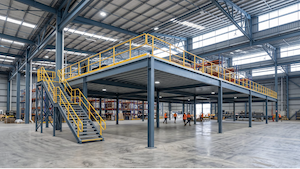 Elevated platforms create new working surfaces, but also new fall exposures around all their perimeters, staircases, and openings for loading and unloading. For warehouses and plants, mezzanine safety begins with four questions: How workers access the surface, how its edges are protected, how materials are transferred across the opening, and whether components are specified as a system.
Plan Access First
Building codes and fire regulations may require multiple access points for mezzanines, depending on the application and local requirements. Staircases are the preferred option, and Cogan’s four mezzanine staircase styles are all rated for IBC and NBCC code compliance and have nonslip treads. The company recommends checking with the local building inspector to determine which of its options best fits the application. Its staircases are designed for a maximum height of 12 feet, with a landing required for any staircase higher than that.
Alternatively, where floor space is limited, a 24 inch platform ladder, some styles of which can be supplied with a welded safety cage, may also be permitted as a means of egress if approved by the local building official.
Protect the Perimeter
Most building codes require a continuous railing system along a mezzanine’s entire open edge. Cogan offers 2-rail, 3-rail, and mesh balustrades, all 42 inches high, as well as self-closing safety gates that can be used to close stairways and ladder landings.
Control the Material Transfer Point
The weakest link in the chain of mezzanine safety is the edge opening where materials are transferred to and from the mezzanine. The size and type of gate that should be specified will depend on the width of the opening and the direction of flow. Cogan’s standard sizes for single-swing gates range from 2 feet 6 inches to 4 feet wide, from 5 feet to 8 feet for double-swing gates, and from 5 feet to 12 feet for sliding gates.
For loading pallets, the Cogan safety pivot gate allows one side to be opened while the other remains closed, presenting a safer alternative to a completely open edge. The gate is described as patent-pending and is available in 12 standard sizes, finished in safety-yellow powder-coated steel.
Specify Components as a System
Gates, handrails, stairs, ladders, and floor panels are most effective when specified as a system that takes into account the structure’s design load and its intended use. Cogan provides installation instructions for its stairs, ladders, handrails, and gates. Responsibility for flooring supplied by other manufacturers should be clarified during quoting.
Managers should also determine which standards apply to their installation. Cogan recommends contacting the local building official or referring to the OSHA stairway and ladder requirements listed on the company’s mezzanine components page.