

 |
Erika Scherman isn’t entering the STAFDA presidency with a single program or a long list of promises.
Instead, she sees an opportunity to rethink how the association serves an industry undergoing significant change.
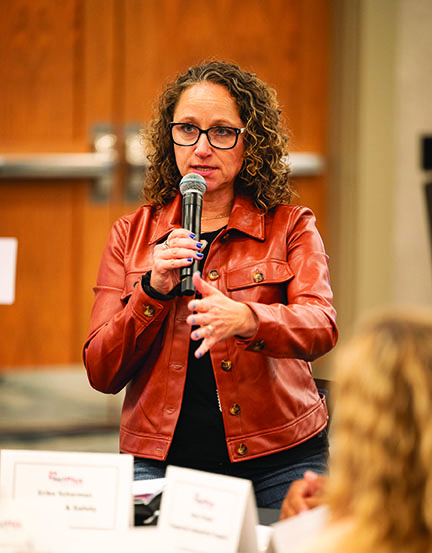 |
| 2027 STAFDA President Erika Scherman |
For Erika, president and owner of MC Tool & Safety Sales in Blaine, Minnesota, the starting point is straightforward: listen to distributors, understand what they need, and use STAFDA’s position as an independent industry association to connect people and resources.
Her immediate priority is more practical: getting distributors to the 2026 STAFDA Convention and Trade Show and making the event a win for members and manufacturers.
Beyond that, she wants to continue gathering input and determining where STAFDA can make the greatest impact.
The construction tool distribution industry has changed significantly over the past decade, shaped by the COVID-19 pandemic, e-commerce and broader economic conditions.
“There are people that still care about face-to-face interaction, there are people who don’t want it, and there are people who buy in bulk,” Erika says. “It’s just different.”
That change, she says, creates an opportunity for STAFDA.
Her priorities include engaging younger industry professionals, exploring closer relationships between STAFDA, other industry associations and distributor buying groups, creating more meaningful connections between distributors and manufacturers, and strengthening advocacy for small businesses.
“There’s not a map for what associations should do in this world,” Erika says. “I think we’ve got the right people, and we’ve got the right group of members and people who care.”
BRINGING IN THE NEXT GENERATION
One of Erika’s priorities is changing how younger professionals view STAFDA and giving them reasons to participate.
Travel costs are rising, digital communication offers more ways to connect, and consolidation continues to reshape distribution. Younger professionals also have different expectations for how they communicate and build relationships.
“I think the first thing is changing how people view us,” Erika says. “The second thing is getting the younger people involved and on the board.”
STAFDA has already increased its social media activity under Frontline’s management, and Erika wants to build on that effort by bringing more industry influencers into the conversation.
“Those kids, that’s how they talk, so why can’t STAFDA have a messaging app?” she says. “There’s got to be some way to interact with the influencers and that next generation, so I’d like to explore that more.”
The objective isn’t simply to put more content online. Erika wants to give younger members a reason to participate in the association.
STAFDA AS “SWITZERLAND”
One of the more ambitious parts of Erika’s vision involves STAFDA’s relationship with distributor buying groups. Rather than competing with buying groups, she sees STAFDA serving as neutral ground where their interests can intersect.
“I think we must find a real meaningful connection for all of them,” she says. “The buying groups are wonderful on their own, but I think their members will be stronger if, as buying groups become members of STAFDA, we can offer more than just what the buying groups offer.”
Erika envisions STAFDA as a neutral organization that can understand what matters to different groups and identify areas of common interest. “STAFDA gets to be Switzerland,” she says. “STAFDA gets to be friends with all of the buying groups.”
That relationship will require listening before action. “What do the buying groups want? What’s important to their members?” Erika asks. “STAFDA can be the Geneva Convention or whatever. We get to be the one in the middle that can take what Sphere One needs, what AD needs, what NetPlus needs and bring all that together.”
She acknowledges the buying groups may not see a need for greater cooperation with STAFDA. “Regardless of how good our ideas are and how good we think the synergy might be, maybe it’s not there,” she says. “I don’t want to make a round peg for a square hole.”
Still, she believes the possibilities are worth exploring. “I firmly believe that STAFDA can be a connecting point for so many things,” Erika says. “And we have to narrow our focus and figure out what’s important.”
RETHINKING INDUSTRY EVENTS
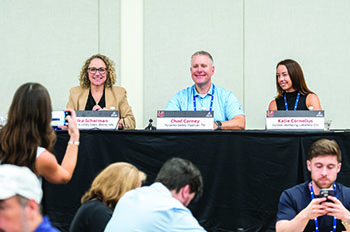 |
| Erika views the annual STAFDA Convention and Trade Show as a key opportunity for change. Here, at left, she is joined by Chad Carney of Pyramex Safety and Katie Cornelius of Dorwin Marketing, who each serve on STAFDA’s liason committees, during the 2025 show in Phoenix. |
The STAFDA trade show and convention is one immediate opportunity for change. With manufacturers and distributors already participating in multiple industry events, Erika believes there may be ways to reduce duplication and make travel more efficient.
One possibility is a more unified event model, with the STAFDA convention serving as the central component. Manufacturers could concentrate product launches and demonstrations in the main exhibition hall while buying groups conduct their own programming.
“With that model, the buying groups wouldn’t have to try and showcase products,” Erika says. “They can literally just have a booth, talk to the people they need to talk to, and not worry about the new product stuff because that would be in the main hall.”
Although existing contracts limit what can happen immediately, she sees opportunities to work with buying groups and other industry events, including World of Concrete.
“I think we all need to be open to that because associations are struggling all over,” Erika says. “I just think creating the opportunity for more interaction is so important.”
CREATING REASONS TO CONNECT
For Erika, the value of STAFDA’s events isn’t limited to products; it’s really about the people.
“I think the world is coming back to the realization that a trade show allows you to have human contact that offers more than just a phone call or a social media interaction,” she says. “That next generation of buyers needs to find that human interaction.”
The STAFDA trade show gives smaller distributors access to products they might not otherwise encounter and manufacturers whose representatives may not have time or economic incentive to visit them. But Erika wants the association to go beyond simply providing a place for people to gather.
Distributors want to see supplier representatives and new products, she says, but they also need opportunities to meet other business owners facing similar challenges.
“You need to build your allies and supporters,” she says. “I can’t lean on all of my friends because they don’t have any experience owning or running a distribution business.”
Her own experience with STAFDA showed her the value of those relationships, although she acknowledges that her first few conventions as an owner were overwhelming.
“You get to know people by attending events and doing new things because you’ve got to build that network of suppliers,” she says. “The next generation needs to realize you can’t only use video games with headsets and chat rooms to meet people.”
Erika sees those connections as particularly important for smaller distributors that don’t have the resources or networks of larger companies.
“If you can find some strategic partnerships so that you can purchase with more authority or with better pricing or with better freight terms, and you can be a better resource for your customers, that matters,” she says.
She doesn’t view consolidation or mergers as inherently negative. Strategic combinations can give smaller companies additional buying power or resources. But she also believes independent distributors need opportunities to connect before consolidation becomes their only growth strategy.
“The STAFDA convention should be fun and educational, and it should be an opportunity for members to meet a lot of new people and really see what sort of synergies they have together,” Erika says. “It should be a forum for people to say, ‘Hey, this is hurting, or this is helping my business, so how can I share or collaborate?’”
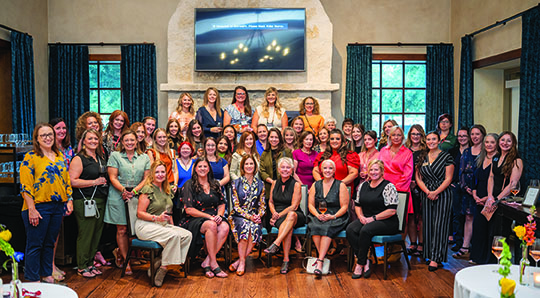 |
| NetPlus Alliance supports women in the industrial distribution sector through dedicated networking communities, virtual meet-ups, and annual events. |
TACKLING PROBLEMS OWNERS CAN’T SOLVE ALONE
Erika sees STAFDA’s role as extending beyond its annual convention. She wants the association to become a resource for small and mid-size distributors navigating consolidation, e-commerce, changing customer expectations and increasing operational complexity.
STAFDA already provides resources including a distributor handbook and webinars covering human resources, payroll and artificial intelligence. Erika’s concern is making sure members know those resources exist.
Her broader idea is to create a forum where members can identify common problems, share what other companies are doing and develop solutions together.
“I want all of those small business things that suck the life out of me for the week, and really take from my happiness, which is serving my customers and making sure we got what we need,” she says. “Let’s find a way to band together and develop a roadmap for how we can solve some of these issues.”
Healthcare is one example. She would like to explore whether STAFDA members could work together to find more affordable health insurance options. “That would be a game changer,” Erika says. “It’s been a challenge to navigate that as a small business.”
She sees similar possibilities around technology, including partnerships that could make website management and other services more affordable for smaller distributors.
“The country needs the small businesses,” Erika says. “It’s a different way to make sure the big companies are in some sort of check and balance. It’s a way to even out the playing field.”
A STRONGER VOICE FOR SMALL BUSINESS
Advocacy is another area where Erika sees room for STAFDA to play a larger role.
“If you look at the average size of a STAFDA distributor, there’s a lot of us at under $10 million,” she says. “So, what do we need?”
Her answer includes a stronger voice in Washington, D.C., and at the state level, particularly around regulations, taxes and policies affecting distributors who operate across state lines. “We need to have an advocate that can voice stuff in Washington, and what better platform than STAFDA,” she says.
Erika points to the Association of General Contractors as an example of the type of advocacy she would like STAFDA to provide, including keeping members informed, providing contacts for local representatives and helping businesses communicate with government officials.
“I would like to see some of that moving forward coming from STAFDA,” she says.
She emphasizes that advocacy doesn’t mean taking a partisan position. “We can’t take a side one way or the other,” Scherman says. “We want to support the government and our small businesses. We want everybody to thrive.”
LISTENING BEFORE LEADING
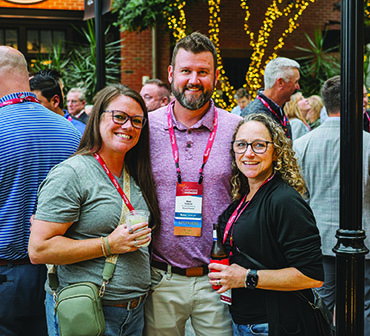 |
| Here Erika, at right, is networking at the NetPlus annual meeting with Heather Terrell Berry, president of Gogel Fastener & Industrial Supply and Matt Dedeluk, vice president sales and marketing at Pro Line Products. |
Despite the breadth of her ideas, Erika isn’t promising that every proposal will become a STAFDA initiative.
She wants the board to remain connected to members and manufacturers and to gather input before establishing longer-term priorities.
“We have to narrow our focus and figure out what’s important,” she says. The process will take time, she acknowledges.
“I think gathering that information, honing that statement and getting that vision really in tune is going to take work,” Erika says.
That willingness to listen may ultimately define her presidency as much as any specific initiative. She is taking over the board at a time when the traditional model for industry associations is being challenged.
“It’s not easy to be leading something in a time of great change,” Erika says. “But I was never put on this earth to do anything easy.”
She believes the last several years have demonstrated that STAFDA has something worth preserving and expanding.
“We can all be pessimistic and say everything’s dying, but at the end of the day, the last five years being a part of STAFDA has been some of the most fun I’ve ever had,” she says.
Now she wants more distributors to experience that same sense of community.
Her challenge will be turning that enthusiasm into an association that is more connected to its members, more useful to small businesses and more collaborative across the broader distribution industry.
“Without somebody to navigate that bigger ship of the industry, we’re all floating without enough direction,” Erika says. “STAFDA has the opportunity to provide some direction.”
She doesn’t pretend to have all the answers.
“I think the challenge is you have various groups and associations that are vying for the same people across the nation, so how do you get them to say, we’ll partner with STAFDA and be one big happy family? I don’t have the answer for that yet,” she says. But she is willing to try.
“I feel good about it,” Erika says. “If you take the time and take the steps for that success, it can happen.”
And, with the bluntness that has become part of her leadership style: “I’m up for the challenge. We’ll see. It’s go big or go home.”
This article originally appeared in the October/November 2026 issue of Contractor Supply magazine. Copyright, 2026 Direct Business Media.

CONTRACTOR SUPPLY MAGAZINE
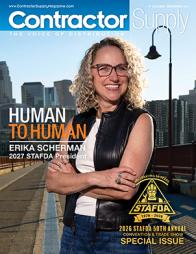
The October/November 2026 issue of Contractor Supply magazine is here!
In our cover story, Human to Human, MC Tool & Safety Sales competes with larger distributors by putting relationships, service and customer knowledge first.
Also in this issue are Industry Updates.
The digital edition, sponsored by BECK AMERICA Inc., is fully searchable and contains live links to every advertiser and new product listing. Click away!
| Read the Articles Read the Digital Edition |