


 |
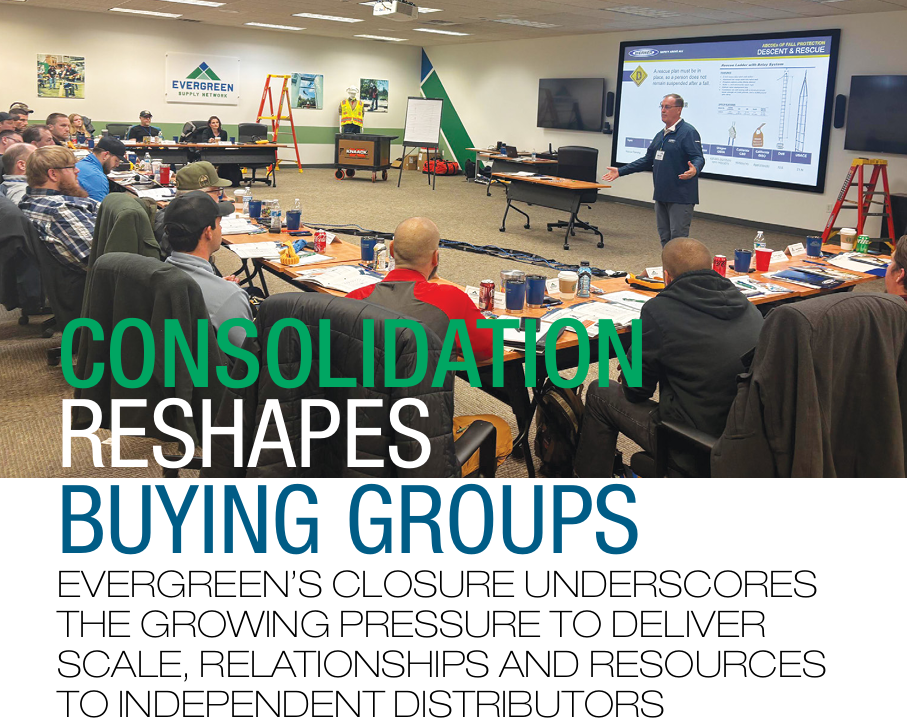
For nearly four decades, Evergreen Supply Network helped independent construction and industrial distributors compete through rebate programs, workforce development and peer collaboration. This summer, however, the cooperative’s board voted to dissolve the organization rather than continue operating under mounting financial pressure.
The decision marked more than the closure of a single buying group. It reflected a broader shift reshaping the construction supply channel as industry consolidation reduces the number of independent distributors, changes the economics of memberowned organizations and forces buying groups to continually redefine the value they provide.
 |
| Miller |
“There comes a point where sustainability for the future has to come into play,” says Jen Miller, Evergreen executive director. “We had to understand what the risks were coming at the organization.”
For Evergreen, those risks centered on a shrinking membership base. As distributors merged, were acquired or expanded beyond the cooperative’s offerings, the organization found it increasingly difficult to generate the scale needed to support its programs while continuing to return value to members.
“In the end, Evergreen hit a point of instability because of the lack of members,” Miller says.
The challenge is hardly unique to Evergreen.
Across the distribution channel, buying groups are adapting to the same market forces. Consolidation has reduced the number of potential members even as independent distributors face growing competition from national companies, increasing expectations from suppliers and customers, and continued economic uncertainty.
Organizations such as Sphere 1, NetPlus Alliance, AD and STAFDA have become increasingly important by helping independents strengthen supplier relationships, expand business opportunities and remain competitive in a changing marketplace.
 |
More importantly, Evergreen’s story offers a case study in how distributor support organizations must continue evolving as the market around them changes.
WHEN CONSOLIDATION CHANGES THE MATH
Evergreen’s dissolution reflected years of industry restructuring that steadily reduced the number of independent distributors available to join or remain in a buying group.
Twenty-five years ago, recruiting new members was far less challenging. Independent distributors were plentiful, providing buying groups with a deep pool of potential members and allowing organizations to spread operating costs across a larger base.
There are roughly 30,000 independent distributors in the U.S., according to the latest census information.
At its peak, Evergreen counted approximately 75 members. By comparison, larger organizations such as AD, Sphere 1 and NetPlus each serve more than 100 distributor members.
AD boasts over 1,400 members, Sphere 1 exceeds 150 and NetPlus maintains a balance of about 400 distributors that make up its membership.
“When you have that many members, the cost and ROI for the distributor is good because you can spread those costs through so many distributors,” Miller says. “The nice part about a cooperative is that while we are all typically profit-seeking corporations, internally to service our members the best, we try to operate as a nonprofit and then split those costs and distribute everything back to the members.”
Like many buying groups, Evergreen provided rebate administration and supplier programs. What distinguished the cooperative, however, was its hands-on approach to training.
Rather than relying on traditional classroom instruction, Evergreen built its education programs around accountability and practical application.
 |
| One of Evergreen’s defining strengths was workforce development at its training center led by Wade McCone. |
Those strengths, however, could not offset the effects of changing channel dynamics.
After Miller joined Evergreen as executive director in June 2024, Evergreen had approximately 40 members. During her first year, she traveled extensively to better understand members’ businesses, supplier relationships and growth opportunities.
One message surfaced repeatedly: the cooperative needed more members to remain competitive and continue expanding its services.
Instead, membership moved in the opposite direction.
By the fall of 2025, Evergreen’s roster fell to 29 members as distributor needs evolved.
Consolidation wasn’t the only challenge. As some distributors expanded into new markets, they required broader supplier portfolios, website capabilities, and access to additional business segments beyond what Evergreen could offer.
“When that happens in six months and the amount of volume that involves, it meant we needed a very large increase of distributors,” Miller says. “It just comes down to so much consolidation happening faster than we could get distributors that are large enough to get a reasonable ROI through Evergreen.”
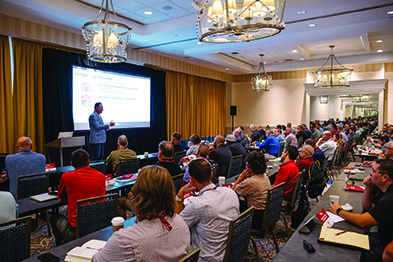 |
| The buying groups’ national meetings, such as the NetPlus event shown here, create opportunities for distributors and manufacturer executives to discuss growth in ways that extend far beyond routine sales calls. |
For Evergreen’s leadership, the issue ultimately became one of scale.
The cooperative continued investing in growth, technology and member recruitment. However, the market for prospective independent distributors was shrinking faster than new members could replace those lost through mergers, acquisitions and changing business strategies.
As Evergreen’s membership declined, the cooperative’s leadership focused on a single question: Could the organization adapt quickly enough to remain sustainable?
The answer wasn’t immediate.
Over nearly two years, Evergreen’s board and leadership team evaluated multiple strategies to strengthen the cooperative’s future including recruiting new distributor members, expanding supplier relationships, investing in technology and exploring whether a partnership with another organization could create greater value for members.
“It just happened so quickly, and you’ve got to move with business and be willing to have those hard conversations,” Miller says.
Among the options considered was an acquisition; Evergreen approached NetPlus with an offer to discuss purchasing the cooperative. The two organizations engaged in discussions as part of Evergreen’s long-term strategic planning.
 |
| Murphy |
According to Jennifer Murphy, President & CEO of NetPlus, Evergreen’s proposal would have included acquiring Evergreen’s training center, retaining its staff led by Wade McCone, and maintaining continuity for cooperative members.
“I really admired the legacy Wade built in the training center opportunity there,” Murphy says, noting that McCone’s programs played a significant role in attracting young people to the industry.
She says the training facility and staff would have complemented what NetPlus already offers.
Ultimately, both organizations concluded the move wasn’t the right fit.
“It’s just like anything else; you go through, you try to learn as much about each other as you possibly can, and when you determine if it is or it isn’t a fit,” Miller says.
Evergreen continued investing in operational improvements and efforts to recruit new members. The challenge wasn’t simply replacing lost members.
Each acquisition removed significant purchasing volume from the cooperative, meaning Evergreen needed to recruit multiple new distributors to offset the impact of member loss.
Eventually, the board concluded that continuing to operate would place member value at greater risk than an orderly dissolution.
 |
| Bay Verte Machinery was recognized as a topper-forming member for Sphere 1 in 2025. |
For Miller, the decision remains one of the most difficult of her career.
“The board and I had many hard conversations to make a very difficult decision,” she says. “Nobody wants to be sitting in that seat, but the realities were there.”
Rather than allowing the cooperative to decline further, Evergreen chose to wind down operations while its members remained well positioned to transition to other organizations.
WHERE EVERGREEN MEMBERS LANDED
As news of the dissolution spread, other buying groups moved quickly to welcome Evergreen members.
Rather than negotiating with Evergreen as an organization, however, each distributor made its own decision about which group best aligned with its business.
For those who moved to Sphere 1, the transition to another cooperative, using a similar rebate platform, represented a natural fit.
 |
| Shumard |
“We had been in discussions with a lot of Evergreen members because of all the things that had been going on in the industry,” says Mike Shumard, president of Sphere 1. “They had some of the best distributors in the country.”
Before Evergreen announced its dissolution, several distributors had already joined Sphere 1. Following the announcement, another 18 former Evergreen members joined the cooperative.
Shumard believes the transition was driven less by rebate programs than by continuity.
Many Evergreen members wanted to maintain the supplier relationships they had spent years building while gaining access to additional manufacturers and business opportunities.
Sphere 1 also moved quickly to preserve another of Evergreen’s defining strengths: workforce development.
The cooperative hired McCone, whose training programs helped establish Evergreen as one of the industry’s respected educational organizations.
“They were the gold standard,” Shumard says.
Rather than recreate Evergreen’s physical training center, which has since been sold, Sphere 1 plans to expand education through a more flexible, nationwide model by partnering with manufacturers and suppliers to deliver training closer to distributor members.
For Miller, seeing members transition into organizations capable of supporting their continued growth helped provide reassurance. “I have 100% confidence that other groups will support and take care of the Evergreen members,” she says.
The transition also reflected a larger trend reshaping independent distribution.
RELATIONSHIPS OVER REBATES
 |
| Building Homes for Heroes is a long-standing charity for the group. |
While rebates often receive the most attention when distributors evaluate buying groups, industry leaders say the financial return is only part of the equation. The greater value lies in something less tangible: relationships.
As consolidation reshapes the distribution landscape and national competitors continue gaining market share, buying groups have become increasingly important by giving independent distributors access to supplier executives, business resources and peer networks they often couldn’t develop on their own.
Like Evergreen, Sphere 1, NetPlus and AD have each experienced the effects of distributor acquisitions and consolidation in recent years.
Shumard says those losses have been offset by new independent distributors entering the market.
“There are still a lot of distributors out there, and they need our buying power and connections,” he says.
That need extends well beyond purchasing programs.
Relationships between organizations and individuals across the industry are significant drivers of growth.
NetPlus adds more than 20 new members annually, on average, to its network of around 400 members. Many of those additions are born out of referrals from supplier partners and independent reps.
Like other groups, Murphy says NetPlus prioritizes distributor-supplier and distributor-distributor relationships through programs and events that bring the community together for frank conversation, goal alignment, and strategic growth ideation.
In addition, the NetPlus team acts as a bridge between distributors and suppliers when needed.
From a broad view, Murphy sees today’s consolidation cycle creating room for a new generation of independent distributors.
“There are always newcomers that emerge as a result of consolidation to start new businesses,” she says. “These distributors need partners and people to help and support them.”
 |
Shumard, Murphy and other industry leaders agree that organizations such as Sphere 1, NetPlus, AD and STAFDA have become increasingly important in helping preserve an independent distribution channel by giving smaller companies the resources to compete with larger national organizations.
“People underestimate the impact that small businesses have,” Murphy says. “Those businesses contribute so significantly to the overall health of communities across the United States.”
Rather than competing aggressively with one another for members, the organizations and associations generally focus on delivering their own mix of services while continually learning from each other’s successes.
Despite differences in organizational structure and methods of promoting growth, Shumard says the long-term value of membership is never measured by rebate checks, but rather by access.
After several years in a buying group, distributors develop more direct relationships with manufacturer leadership, connections that can help resolve supply issues, identify new opportunities and strengthen long-term business partnerships.
“We can go to the next level,” Shumard says. “If distributors are not getting what they need on a local level, they can pick up the phone and call their person or call us.”
Those relationships are built intentionally.
National meetings, educational programs and supplier events create opportunities for distributor owners and manufacturer executives to discuss business performance, market conditions and growth strategies in ways that extend far beyond routine sales calls.
“Everything lives and dies by relationships, and that’s why we are so hyper-focused on that,” Shumard says. “That’s what drives distributors’ success in the market.”
For independent distributors, that access has become increasingly valuable.
National chains may enjoy greater purchasing power and broader geographic reach, but Murphy believes local distributors continue winning business through responsiveness, flexibility and customer service.
She says buying groups exist to strengthen those businesses rather than replace what already makes them successful.
“As things change, we really work to meet people where they need to be and provide those resources,” Murphy says. “Any support that can be pushed toward independents, whatever flavor of group they’re looking for, the attributes that we provide are really meant to help solidify and support the businesses that are in the channel.”
For today’s independent distributors, rebates may open the door to a buying group. It’s the relationships behind those rebates that keep members engaged.
A SHARED MISSION
 |
| For distributors, the STAFDA show provides opportunities for relationship building with suppliers. |
While buying groups and cooperatives provide critical business resources for independent distributors, industry leaders say trade associations serve an equally important role in strengthening the channel.
Organizations such as STAFDA and ISA provide a broader platform for education, networking and industry engagement, complementing the supplier relationships and business strategies developed through buying groups.
Murphy says buying groups and trade associations should view each other as partners working toward a common goal: supporting independent distributors.
“We really should all be in support of the associations and continuing to help them survive and thrive,” Murphy says.
Murphy says she and Erika Scherman, 2027 STAFDA president, have discussed opportunities for buying groups and STAFDA to work more closely together.
NetPlus leadership attends the STAFDA show each year and encourages members to participate because of the long-term value the association provides.
“There are a lot of values to the association and a lot of long-term history that I feel people in our industry still need to support,” Murphy says.
The difference between buying groups and industry associations comes down largely to their purpose. Buying groups focus primarily on helping distributors improve their businesses through supplier relationships, rebate programs, education and strategic resources.
Associations provide a broader industry connection, bringing together manufacturers, distributors and other professionals through networking, education and product-focused events.
For emerging distributors, associations can provide an important entry point into the industry. Most buying groups look for members with an established track record, making associations an important resource for newer companies seeking education, supplier connections and industry knowledge.
“We don’t need people coming in and leaving because they go out of business,” Shumard says. “That just makes STAFDA the perfect starting point for them. That’s what they need; they go connect with manufacturers; learn about all the products and different areas they can sell in.”
Murphy says attracting younger professionals will be essential to the future. “We have to keep enticing young people,” she says. “I think that’s a really important component for the future health of the industry.”
For both buying groups and associations, the common objective remains the same: helping independent distributors build stronger businesses through education, relationships and access to resources.
 |
| 2027 STAFDA President Erika Scherman and NetPlus CEO Jennifer Murphy have discussed ideas for buying groups and STAFDA to work more closely together. |
LESSONS FROM EVERGREEN
For Miller, Evergreen’s closure serves as both a difficult ending and an important reminder for organizations throughout the industry.
The cooperative’s experience demonstrates how quickly market conditions can change and why organizations cannot rely solely on past success.
Strategic planning, diversification, and ongoing risk assessment are essential as market forces reshape the distribution channel.
“I can’t express how important that is for every organization, no matter what the industry, to prepare for any risks that can come at you because things change very quickly,” Miller says.
While Evergreen’s operations have ended, Miller believes the cooperative’s impact will continue through the distributors, suppliers and industry professionals who were part of its history.
The relationships built through decades of collaboration, the training programs developed through the cooperative, and the commitment to helping independent distributors compete remain part of the organization’s legacy.
“It’s a sad ending to an amazing legacy,” Miller says.
But the industry’s response also illustrates the strength of the independent distribution community.
As consolidation continues changing the channel, buying groups, cooperatives and associations will continue evolving to provide the relationships, resources and support independent distributors need to compete.
This article originally appeared in the October/November 2026 issue of Contractor Supply magazine. Copyright, 2026 Direct Business Media.

CONTRACTOR SUPPLY MAGAZINE



The October/November 2026 issue of Contractor Supply magazine is here!
In our cover story, Human to Human, MC Tool & Safety Sales competes with larger distributors by putting relationships, service and customer knowledge first.
Also in this issue are Industry Updates.
The digital edition, sponsored by BECK AMERICA Inc., is fully searchable and contains live links to every advertiser and new product listing. Click away!
| Read the Articles Read the Digital Edition |