

 |
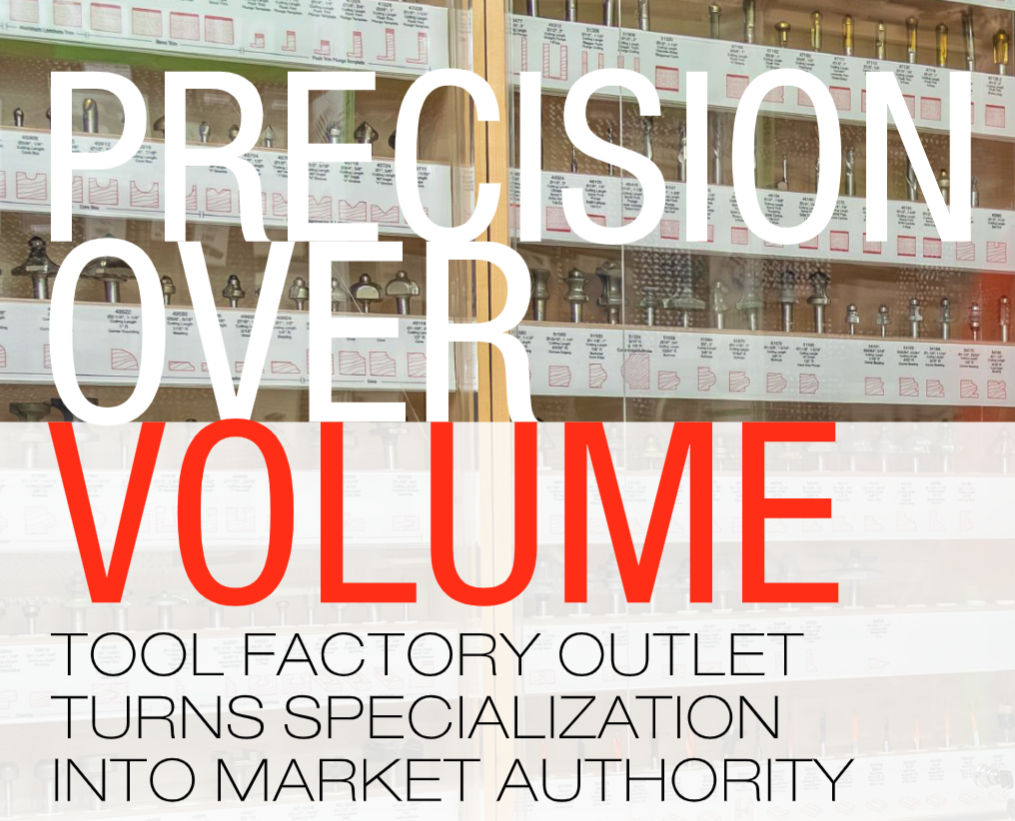
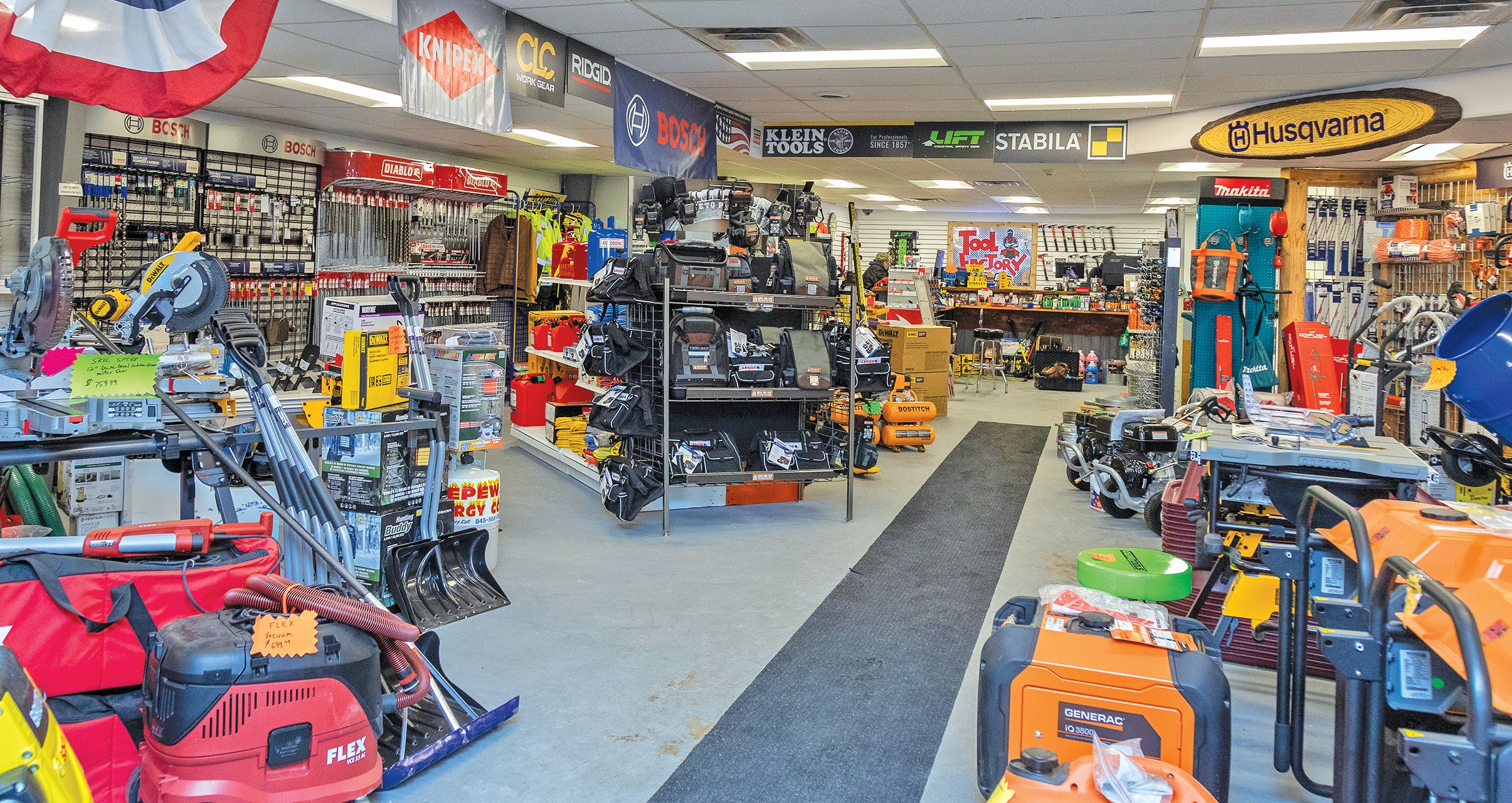
Tool Factory Outlet in Goshen, New York is not a general hardware store trying to be everything to everyone. It is a focused contractor supply operation built on niche brands, technical expertise, and the belief that specialization not commoditization is the path to long-term survival.
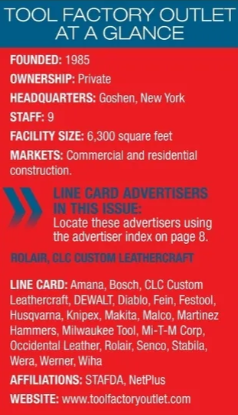
The operation was founded by the Schindler Family in 1985 to satisfy the demand for professional grade equipment that was not widely available at the time.
It became more than another retail outlet, it became a destination for tradespeople, not only for tools, but for guidance, sourcing capabilities, and a depth of knowledge that larger retail formats often struggle to provide.
Longevity in retail is rarely accidental. Tool Factory Outlet’s staying power has been rooted in a catalog-like breadth of inventory, personalized assistance, deep product knowledge, and a consistent commitment to stocking what contractor clients truly need.
Those principles remain intact today under owner Dan Dickinson, who has maintained the store’s status as a model of what disciplined specialization can achieve.
Today, customers routinely travel up to two hours from across New York, New Jersey, and Pennsylvania to shop in person for brands and products that are not widely carried in their local markets.
Through its website, the company now sells nationally and internationally, with an unexpectedly strong customer base in the United Kingdom.
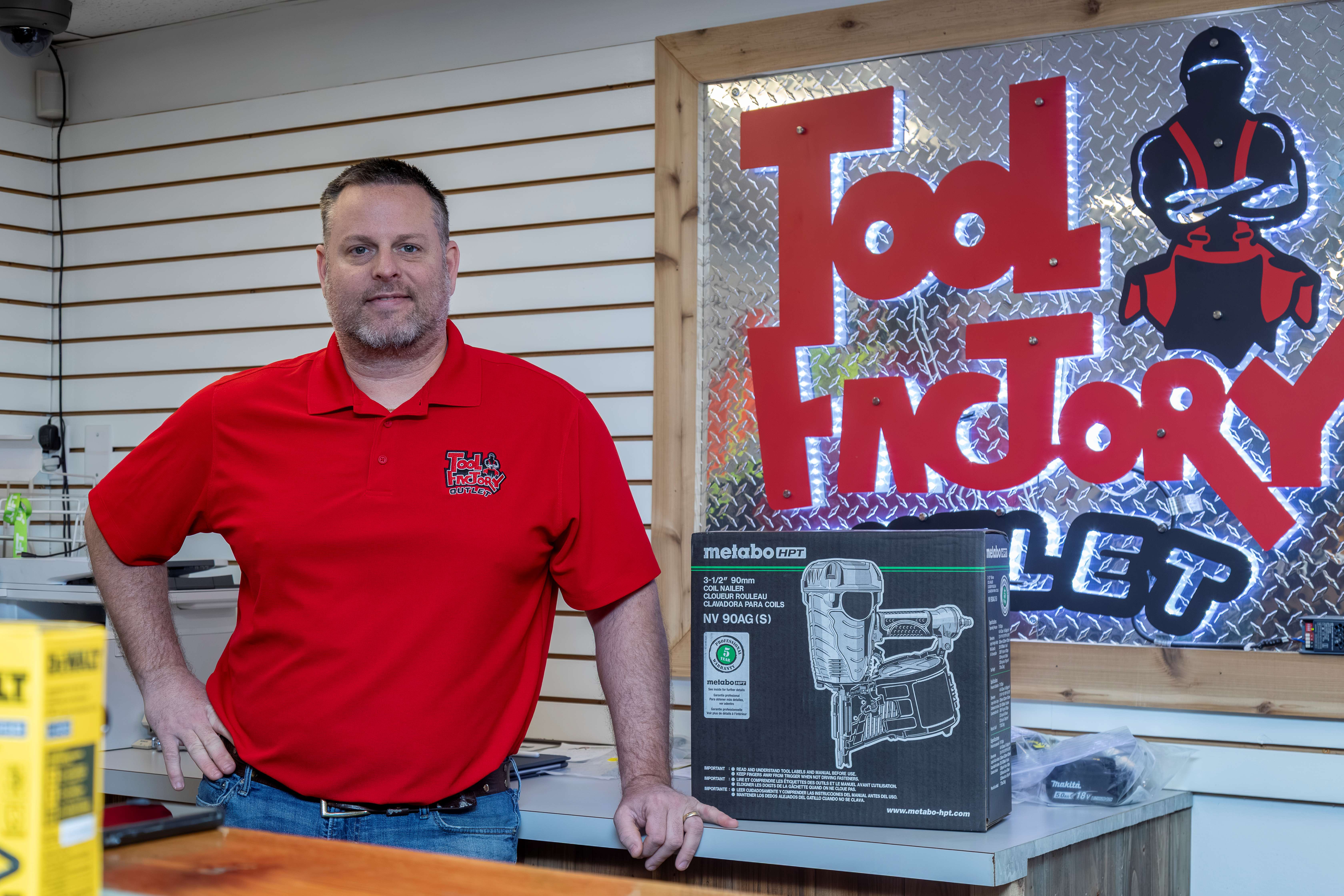 |
| Owner Dan Dickinson operates Tool Factory Outlet under the philosophy of constant improvement and continuous evolution. Photo by Denise Medive. |
THE PIVOT
When Dan acquired the business, the transition reflected the same measured approach that now defines the company’s strategy.
Looking at his resume, someone might question how he went from a registered nurse in the operating room to owning a contractor supply store.
However, Dan doesn’t look at it from that perspective for a couple of reasons.
First, he says construction has always been a part of his life. Even as an RN, he was routinely emersed in various renovations, real estate projects, or apartment turn-overs within his rental property portfolio.
“I’ve always been in remodeling, construction and real estate, so the construction industry has never been far from me,” Dan says.
Owning a business has always been a long-term goal. He had been preparing financially and strategically for the right opportunity.
With his feet firmly planted in the Hudson Valley construction industry, he was very familiar with Tool Factory Outlet as a customer.
“I always liked the store because it was always a special place,” Dan says. “Tool Factory Outlet is like a fixture in Goshen. Everyone knows the store because it’s been here for so long.”
On a personal level, he always appreciated the store because of the quality of products the store carried, those that were not available at Home Depot or Lowes.
“When I was looking for something to purchase, I wasn’t just looking for a hardware store,” Dan says.
“I wanted a contractor supply store, something that had carved out its own niche, and this store fit that bill.”
The timing aligned when he took a gamble and reached out to the former owner about a possible sale.
“If you don’t ask, you don’t get,” Dan says.
The business was not publicly marketed for sale, but the owner was open to the conversation.
Dan says when he purchased the business, he essentially took the entire store and renovated every aspect of it, both physically and operationally.
However, he understood the store’s reputation, its niche positioning, and its role in the community, so the ownership transition was a smooth process.
All the former employees stayed on.
“I didn’t really have any problems,” Dan says. “It was smooth in the fact that everyone saw what I was doing and they wanted to help, rather than to go against the grain.”
The showroom was effectively gutted and rebuilt with new fixtures, updated checkout counters, modern office space, and renovated restrooms.
Upgrades to just the website alone cost more than $45,000 to ensure the operation could compete in a digital-first environment.
“People say that they do it themselves, and we do work on it ourselves, but there’s just too much stuff as far as integrations and the feed from our distributor that went above my head and my pay scale, and it just added up,” Dan says. “I initiated everything because otherwise we weren’t going to go smoothly into the next decade.”
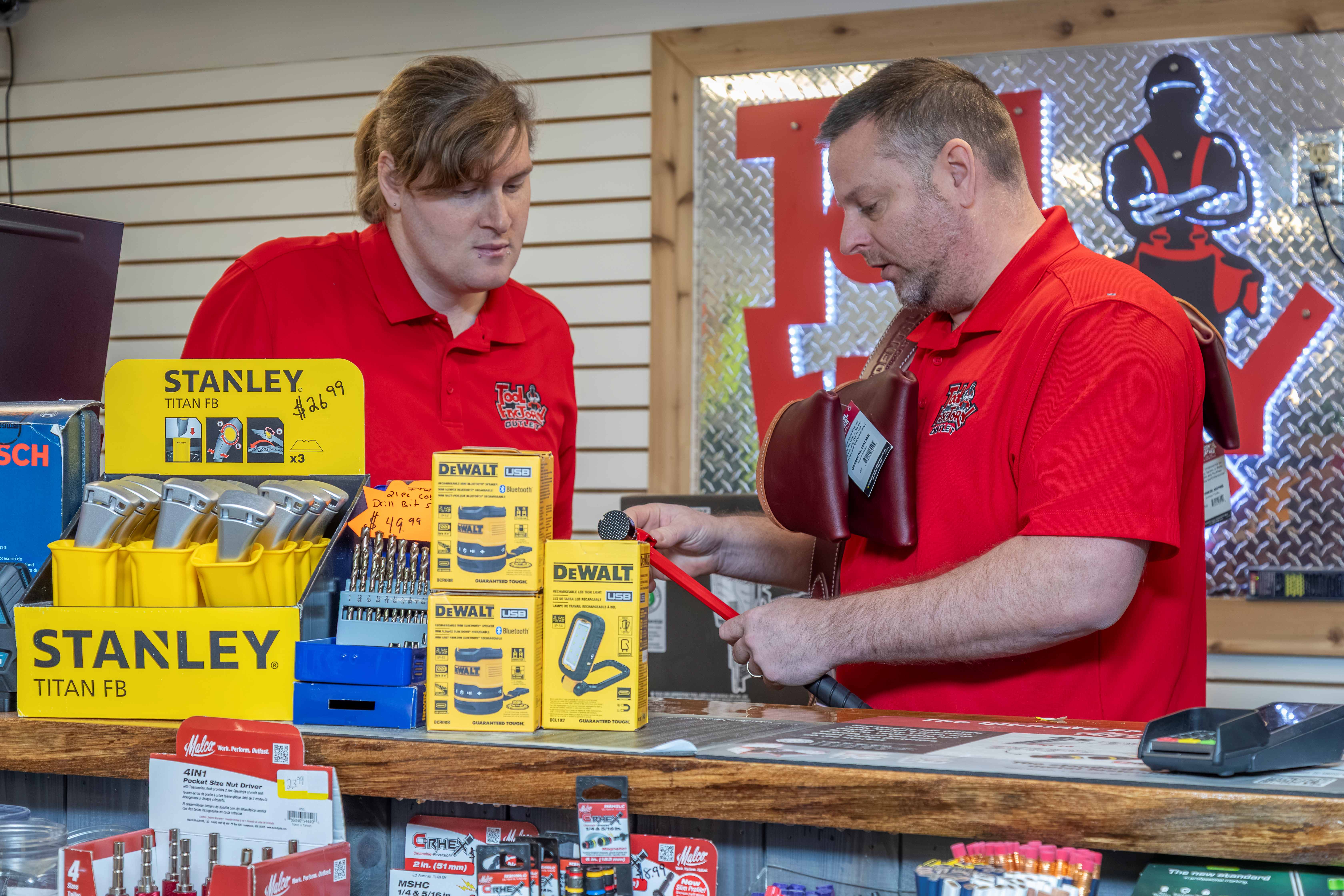 |
| Tool Market Outlet’s inventory is constantly under review. Customers are able to rely on the expertise of the store’s staff like Collin Lindsay, left, and store owner Dan Dickinson. Photo by Denise Medive. |
PRO FOCUS
Tool Factory Outlet’s overall customer base extends across the tri-state area of the Hudson Valley including portions of New York, New Jersey and Pennsylvania.
“People will drive two hours to come to us, for Occidental Leather especially,” Dan says, noting that Rolair compressors are another item that brings customers from further distances.
“There’s just no one else that has it,” he says. “It’s vitally important because that’s how we survive, we have things that other people don’t carry.”
Inventory is constantly under review.
“If it doesn’t sell, we don’t carry it,” Dan says. “That’s how much an exact science it is for us to survive. We can’t have inventory tied up that doesn’t sell, so we’re constantly going over it, constantly going through it and only carrying A-level movers.”
This approach is particularly important when competing against Home Depot, Lowe’s, and online sellers. Tool Factory Outlet does not attempt to compete through sheer volume, instead it competes through precision, specialization, and knowledge.
“We don’t compete against private tool stores because there aren’t any,” Dan says. “It’s the big box stores mainly and online.”
General contractors, carpenters, roofers, siders and framers are the core market for Tool Factory Outlet. Although professionals are the primary focus, Dan says DIYers also are frequent customers.
“We don’t focus on the homeowner, but we want their business,” he says. “There’s no reason why we can’t serve both.”
With nonprofessionals, Dan says the key is education.
“They love that because they’re not getting that at Home Depot,” he says. “They can go there and pick something off the shelf that we carry, but no one is going to be telling them what fasteners to use or not use, when to oil or not oil the machine and whether or not they should keep something in mind that’s particular to that tool or any other little details.”
At Tool Factory Outlet, Dan says customers will get walked through all those details.
“They love the advice and that’s our thing, that’s how we keep people coming back,” he says.
Altogether, the store has nine staff members who keep things going, including deliveries within an approximate 20-mile radius, seven days a week.
“We’re not doing a ton of deliveries at this point because we’re still trying to ramp up,” Dan says, noting that whoever is available takes care of it.
With the size of the equipment, no commercial license is required as anything will fit into a van or pickup truck with a ladder rack.
FINDING A NICHE
Tool Factory Outlet offers in-house tool repair, retail, delivery and e-commerce solutions.
Currently, in-person sales are the strongest source of revenue for the store because of ongoing brand recognition and trust that Tool Factory Outlet will have the right products.
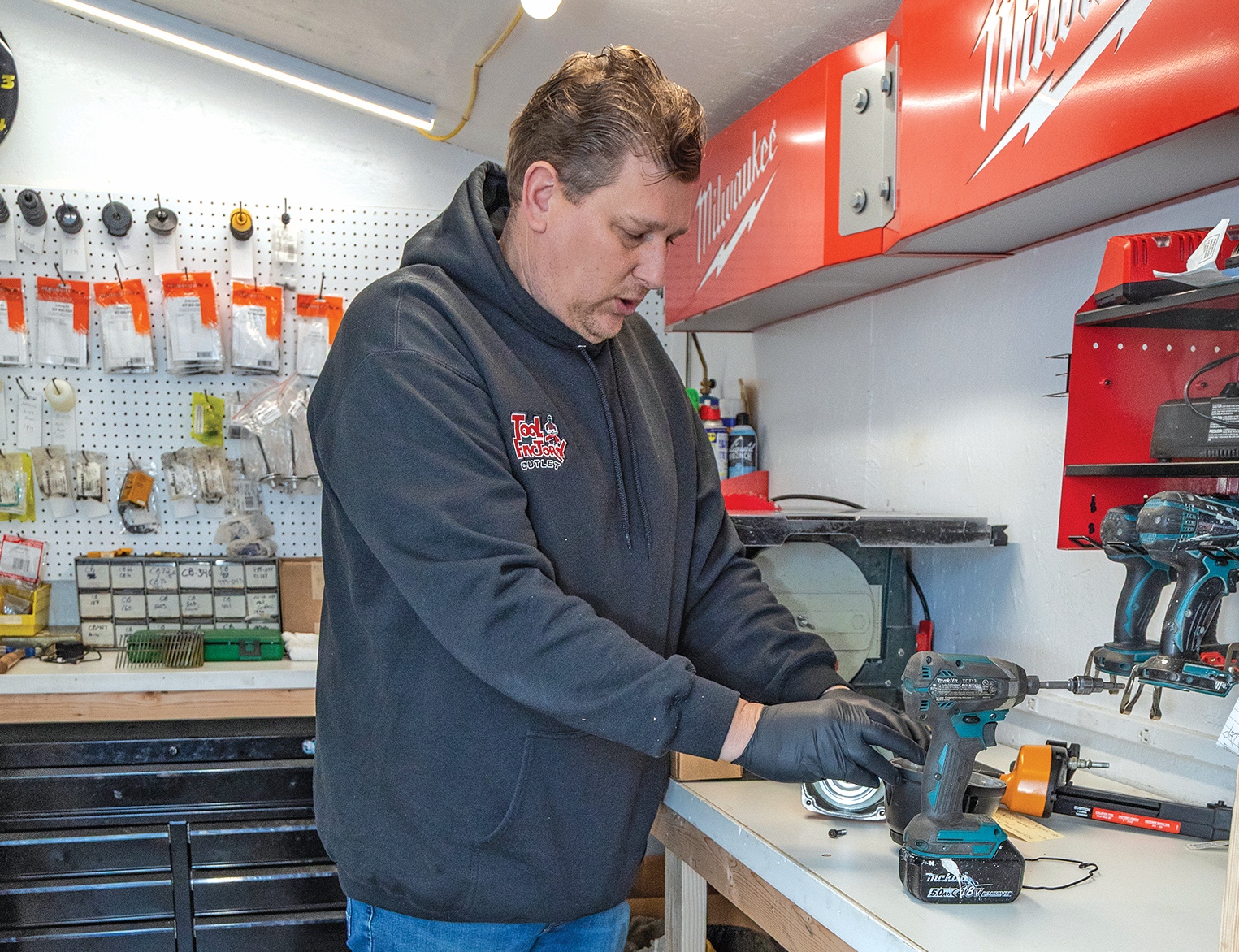 |
| For Tool Factory Outlet, mechanic Troy Arnold focuses on repair of pneumatic tools and nailers, compressors and cordless tools. The niche level of service separates them from competitors. Photo by: Denise Medive. |
The store’s recently upgraded website, which offers more than 40,000 SKUs, is still gaining traction in SEO as people are finding the page and it roots itself in the digital world.
The estimate is that it will take about three to five years for the website to start having the reach that it should.
Dan says his long-term vision is for e-commerce to grow into an equally powerful revenue stream as the in-person sales.
“In this day and age, you need to have that e-commerce aspect as a retailer, otherwise, by default, you’re going to be left in the dust,” he says.
Tool Factory Outlet’s website utilizes Shopify for its e-commerce platform.
While integration with the store’s inventory system is not ideal, the platform provides a broad reach needed in this digital age.
“We have no complaints with it because it allows us to have a large overarching reach,” Dan says.
Repair work provides another alternative revenue stream with different margin characteristics than retail inventory. It also reinforces credibility with contractors who rely on uptime.
Tool Factory Outlet focuses primarily on pneumatic tools, compressors, pneumatic nailers, and cordless tools.
Dan says they also have developed a particularly strong niche around servicing Rolair gas compressors, an area where regional repair options are limited.
“We do those because we try and find areas where we can be super niche,” he says.
Within the store’s general geographic range, there are a few other options to purchase Rolair compressors. Tool Factory Outlet stands alone as a repair option for the compressors, along with direct, regular communication with the factory.
“We get a lot of Rolair business, and we don’t want to do anything to jeopardize that,” Dan says.
While many places have small engine repair options, he says Tool Factory Outlet is not that.
“We try and stay focused on pneumatics and cordless power tools and that keeps us busy,” Dan says.
The store employs a dedicated mechanic who has worked there for 35 years. His depth of knowledge contributes to the technical depth that differentiates the operation from big-box competitors.
Tool Factory Outlet’s repair facility is housed separately and has been renovated to ensure that service operations do not detract from the retail experience, its primary focus.
PRICE REALITY
Operating a professional retail tool business is far from passive.
Tariffs and widespread price increases placed intense pressure on the entire supply chain in his first year as owner.
“It was scary, I don’t know another word to describe it,” Dan says. “It was just unsettling and just threatened the core of what we do.”
As a distributor, he says Tool Factory Outlet doesn’t just sell things.
“There’s a lot of festering behind the scenes,” Dan says. “It’s a war zone on any given day.”
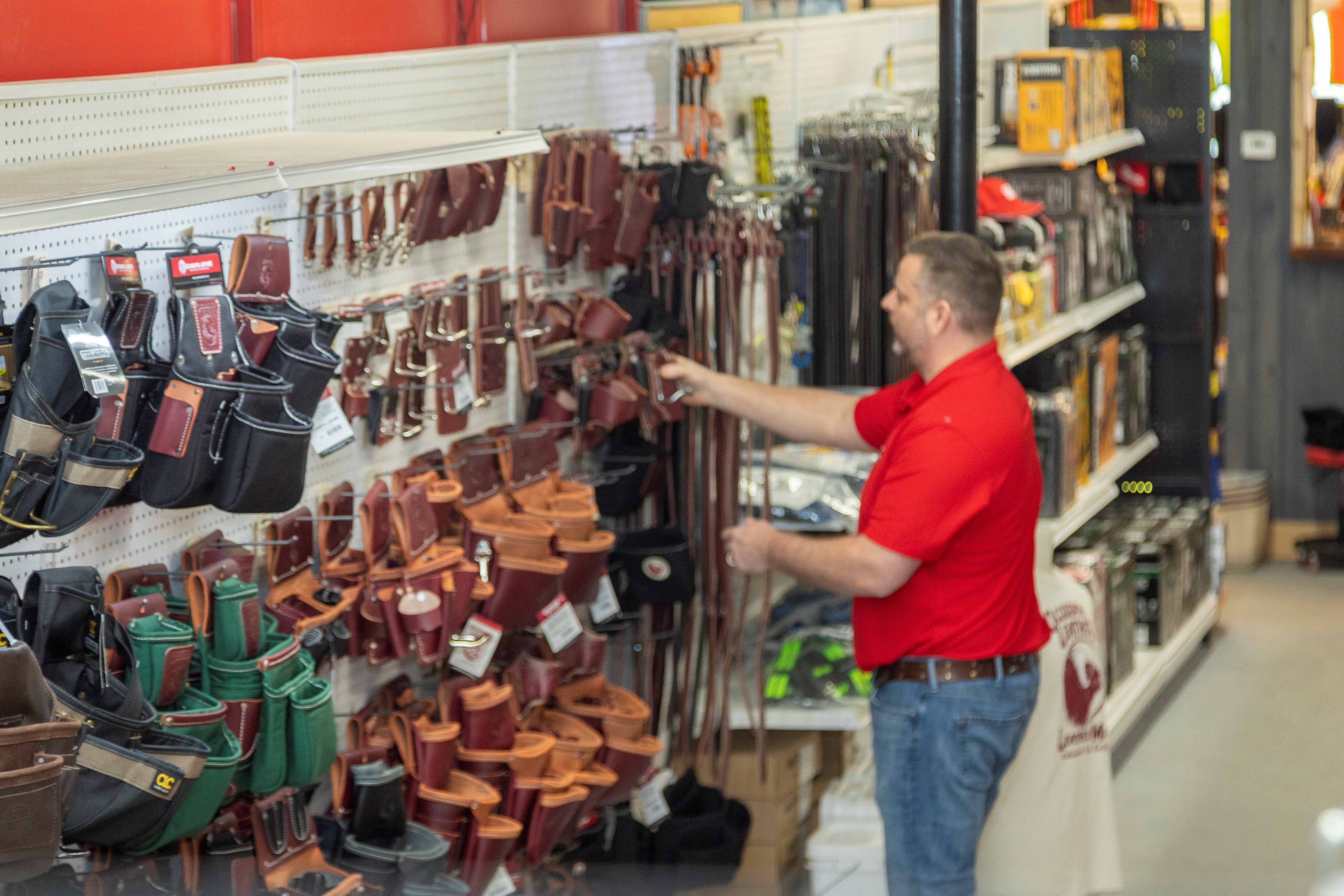 |
| Trade professionals drive up to two hours to visit Tool Factory Outlet’s diverse inventory of products such as Occidental Leather tool carrying systems. Photo by Denise Medive |
Costs rose at the manufacturing level and flowed through distribution and retail.
“They’re (contractors) buying tools to make a living themselves, and when their costs go up, then the prices go up to their customer,” Dan says.
Tool Factory Outlet operates on markups that often leave little room for absorption of those increases, seeing margins as low as 16% for some premium brands.
“We’re the last stop before the customer buys the product, so how do I absorb the increase where I’m already absorbing the brunt of it as a retailer,” Dan says.
With everyone trying to squeeze profit out and put the increases into their own pocket, it made it a difficult time across the entire supply chain.
“It basically equated to prices going way up for everyone and it was not taken lightly,” Dan says. “When the customers know they’re paying too much and we’re turning customers away, it’s a real threat.”
Without assistance from manufacturers, Tool Factory Outlet had no choice but to raise prices.
“We didn’t absorb anything because we just can’t,” Dan says. “When the prices went up to the customer it was because we raised them.”
Contractors were seeing price increases across the board, which helped reinforce that the store was not acting independently of broader economic forces. Even so, rising costs affected purchasing behavior.
“There’s no way for them to think that you’re kind of telling them a fable because everywhere they go, their prices were going up,” Dan says. “We’re all in the same economy, which is a fishbowl.”
People were understanding, but at the end of the day, he says customers were still making decisions not to buy, delaying purchases or seeking alternative options because the prices were too high.
“It’s just old school economics,” Dan says. “They’re just trying to get around the cost with the same outcome.”
This environment forced Tool Factory Outlet to sharpen its strategy.
Product selection became more tightly aligned with seasonal demand and active market trends.
“You must be more creative as far as the products that you pull in so that you’re selling more products even though costs went up,” Dan says. “It’s a mixture of things that you have got to rely on, because if you’re idle, you’re just going to get run over in this business. You can’t do it unless you’re completely on top of your game and always innovating.”
 |
OPERATIONAL REALITIES
As an independent distributor operating within the broader hardware umbrella, Tool Factory Outlet faces some operational trade-offs familiar to many peers.
There are limited options for singlelocation specialty retail stores when it comes to software management systems.
Comprehensive point-of-sale and CRM systems designed for large lumberyards and multi-location chains can cost upward of $500 per month plus devices, excluding hardware, essential integrations or custom features.
“For the price, there’s a lot of functionality that we would get if we were to pay for it, but that we don’t necessarily need,” Dan says. “What that forces us to do is compartmentalize and pigeon-hole different programs from here and there and juggle them.”
Balancing functionality and cost, that juggling act is a common solution among independent distributors.
“You must be a sizable operation to make it worth having those big computer software guys on your side,” Dan says.
Minus the overall size component such as 84 Lumber or ABC Supply, he says it just doesn’t make good fiscal sense.
“The program will save us a lot of time, but for a price, and we’re just not there yet,” he says.
Like the store itself though, Dan says the software systems at Tool Factory Outlet are not static.
He expects it to continually evolve as business grows and technology improves.
STAY SHARP
Tool Factory Outlet is a member of the NetPlus buying group and STAFDA.
 |
“We’re part of that buying group because we get a sizable rebate from them every year,” Dan says.
As for STAFDA, he admits that he has not had the opportunity to take full advantage of membership, being in only his second year of ownership.
“I do want to become more involved in STAFDA though,” Dan says. “It’s an excellent resource and you’re pretty much plugged in to the industry at large when you take advantage of what they have to offer.”
He recognizes that attending trade shows and networking with other members of STAFDA and NetPlus is important.
“You get to know the people in the industry,” Dan says, noting that people know the brands, the faces and the stories. “It’s a small industry, but not really.”
Looking forward, he says expansion is always a possibility if financial conditions support it. “I can’t help but to want to grow,” Dan says. “I mean, I’ll never scale back, I just want to constantly expand.”
For now, the focus remains on refining the current operation, strengthening digital presence and maintaining disciplined execution.
“I’ve been told by others that have been in the industry that you get to that point at some point in time, just by following through and giving your customers what they’re asking for,” Dan says. “As far as timeframe for another location, I don’t know anyone personally that has grown the same type of store.”
In a marketplace defined by tariffs, rising costs, technological shifts, and dominant national competitors, Tool Factory Outlet has survived and grown by staying focused, staying relevant, and refusing to be generic.
“People know our store is a tool store, there is no guessing in the community,” he says.
From renovating the entire business to investing heavily in e-commerce, Tool Factory Outlet operates under the philosophy of constant improvement. As software, products and the economic conditions evolve the business must evolve with them.
The store continues to serve as a contractor destination in the Hudson Valley. Four decades in, the independent model, rooted in specialization, service, and adaptability remains not only viable, but powerful.
This article originally appeared in the April/May 2026 issue of Contractor Supply magazine. Copyright, 2026 Direct Business Media.

CONTRACTOR SUPPLY MAGAZINE
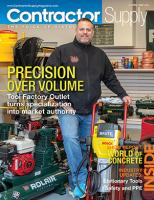
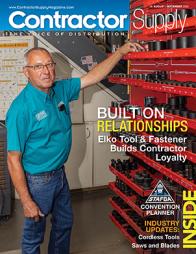
The August/September 2026 issue of Contractor Supply magazine is here!
In our cover story, Built on Relationships, Elko Tool & Fastener of Elko, Nevada has found success in the mining market by offering good customer service.
Also in this issue are Industry Updates.
This digital edition, sponsored by BECK AMERICA Inc., is fully searchable and contains live links to every advertiser and new product listing. Click away!
| Read the Articles Read the Digital Edition |