




 |
Construction is a primary driver for continued growth within the angle grinders and sanders tool market. The use of grinders and sanders across large-scale infrastructure projects and smaller residential developments make it a cornerstone tool within the industry.
Manufacturers today are producing grinders and sanders which are more powerful, designed ergonomically and enable workers to provide the best finish possible.
DEWALT
Despite past concerns about power differences, Nikki Brandt, senior product manager at DEWALT, says cordless tools can now provide comparable power to pneumatic tools.
As an example, she says DEWALT’s just released ATOMIC 20V MAX 4-inch angle grinder provides up to 44% more power than 0.7 HP rated pneumatic angle grinders and is 13% lighter than competitive pneumatic angle grinders in use.
Brandt says several design features are considered during the development process in hopes of making users more productive.
First and foremost, safety is a non-negotiable aspect that users expect and demand.
“Large contractors and industrial users are mandating more safety features including kickback control and brakes on grinders used onsite,” she says.
All DEWALT’s new cordless grinders include the company’s PERFORM AND PROTECT anti-rotation system that quickly stops the wheel when a pinch, stall, or bind-up event is sensed, reducing reactionary torque to help maximize user control.
“It is important that tool manufacturers continue to prioritize safety and eliminate misuse as they look at additional ways to innovate,” Brandt says.
Like other tool segments, she says DEWALT is continuing to see the drive from key users to improve cord and hose management and maximize productivity. For many, a key to unlocking productivity is transitioning from pneumatic to cordless tools.
“Larger, more powerful motors enable heavy-duty cordless grinders to provide ample power for demanding applications,” Brandt says, adding that there is now a higher ‘power ceiling’ for cordless tools.
She says that makes the option of cordless grinders more universal and has been a big driver in professionals making the transition.
Brandt says DEWALT spends countless hours with users in the field learning about what they need and how they utilize their tools, allowing engineers to make innovations to improve performance, ergonomics, and ease of use, while ultimately driving productivity.
“Purposeful design helps users work quicker and more efficiently,” Brandt says. “For example, there is an advantage in spending less time changing accessories or guards and designing the tool to be intuitive based on the user’s behaviors.”
Improvements such as making the tools more compact and able to be utilized in tighter spaces helps reduce fatigue and make the overall jobsite safer.
Going forward, she said DEWALT will continue to pursue electrification in grinders, focusing on safety, efficiency and productivity on the jobsite.
 |
|
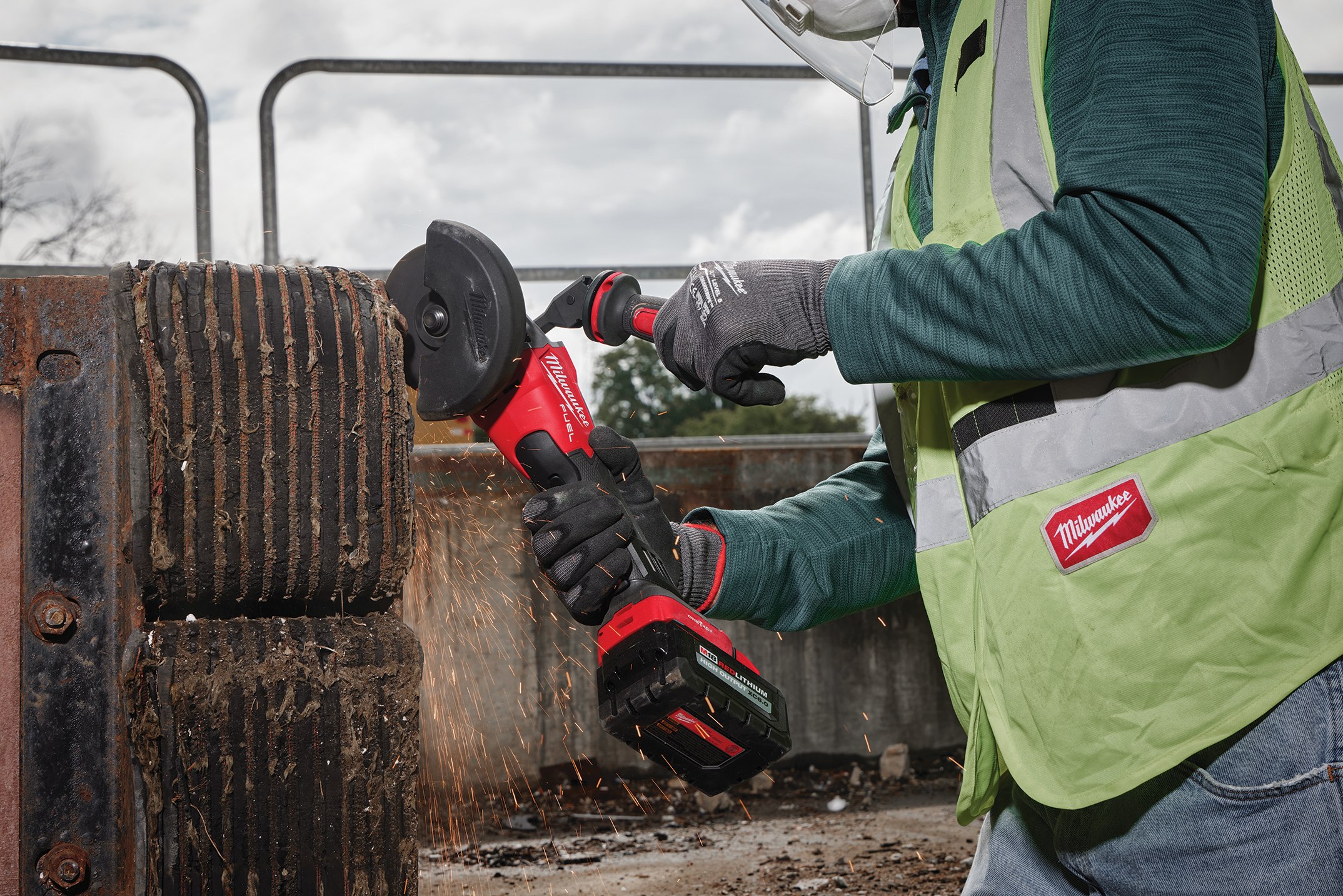
The latest addition to Milwaukee Tool’s line of grinding solutions is the M18 4 1/2 to 6-inch dual trigger braking grinder that delivers 135 cuts in 1/2-inch rebar on a single charge. |
MILWAUKEE TOOL
From the perspective of Daniel Blythe, group manager of product marketing at Milwaukee Tool, the metalworking industry and grinder specific category is experiencing strong, sustained growth.
He says the momentum is largely driven by increasing demand for safer, more productive, and more portable solutions. Like many other tools, cordless grinders are reshaping users’ expectations of portability and durability.
“While many contractors are just now making the initial switch to cordless for convenience, they’re quickly discovering the broader benefits,” Blythe says. “Once converted, users can continue to step up within the platform, moving to higher-performance cordless models with larger wheels, enhanced features, and greater runtime.”
Compared to corded tools, Blythe says cordless grinders tend to be more durable, with fewer mechanical vulnerabilities such as frayed cords or brushed motors. Lighter, more compact and ergonomic designs are helping reduce fatigue and making the tools easier to control over a long period of time.
Also, he noted that development of platforms like Milwaukee’s ONE-KEY are enabling inventory management, tool tracking, and usage analytics, features that are increasingly valuable to contractors managing larger fleets or teams.
Blythe says one of the most common misconceptions is that cordless grinders can’t match the power or runtime of their corded counterparts.
Today’s cordless platforms, especially those built on advanced brushless motor technology and high-output batteries such as the Milwaukee Tool M18 REDLITHIUM FORGE, are delivering performance that rivals or even exceeds their corded counterparts.
“Manufacturers like Milwaukee are designing systems that prioritize user experience, control, and productivity,” Blythe notes. “The result is a cordless grinder category that’s more specialized and performance-driven than ever before.”
Even with the enhancements being made by multiple manufacturers, distributors and end users can misunderstand some of the improvements.
“It’s critical for distributors and key decision-makers of companies to understand how these features work and why they matter, so they can help users make informed choices,” he says.
Distributors are consistently facing the challenge of keeping up with rapidly evolving product portfolios and educating their teams and customers on these latest innovations.
“To stay ahead on these shifts and trends, distributors should focus on a few key things,” Blythe says. “They should put an emphasis on educating their employees and customers on enhanced features and proper usage. Staying current with industry trends and product advancements is essential to meeting customer needs and building long-term trust.”
He says the future of grinders is cordless, and control driven, noting that Milwaukee Tool has already stepped into this space with over 16 M18 grinders.
“These grinders combine high performance with advanced features and control,” Blythe says. “As cordless systems continue to evolve, innovations in battery tech, tool connectivity, and ergonomic design will unlock even more possibilities for professional users.”
LEARN MORE
This article originally appeared in the December 2025/January 2026 issue of Contractor Supply magazine. Copyright, 2025 Direct Business Media.

CONTRACTOR SUPPLY MAGAZINE



The August/September 2026 issue of Contractor Supply magazine is here!
In our cover story, Built on Relationships, Elko Tool & Fastener of Elko, Nevada has found success in the mining market by offering good customer service.
Also in this issue are Industry Updates.
This digital edition, sponsored by BECK AMERICA Inc., is fully searchable and contains live links to every advertiser and new product listing. Click away!
| Read the Articles Read the Digital Edition |