

 |
How Idaho Tool Competes and Wins
In an era when e-commerce giants and big-box retailers dominate much of the contractor and industrial supply conversation, the continued success of independent distributors often hinges on their ability to differentiate themselves in ways that extend beyond price.
Idaho Tool offers a compelling example of how a legacy business can evolve while preserving its foundational strengths, leveraging deep customer relationships, technical expertise, and a service-first mindset to carve out a resilient niche in a competitive marketplace.
That philosophy, rooted in immediacy, expertise, and advocacy, has guided Idaho Tool through more than four decades of change.
The store’s story begins with two partners, one, a former tool store owner, and the other, a concrete truck driver. Together, they opened the store in 1981, laying the foundation for what would become a staple in the local contractor supply ecosystem.
From its origins, the business grew steadily over the years, not through relocation but through expansion, now serving as a regional destination for contractors, mechanics, and manufacturers.
Additions, six or seven in total, transformed the store from a roughly 1,000-square-foot operation into a sprawling facility with 8,000 square feet of showroom space, another 8,000 square feet of storage, and approximately 4,000 square feet of office space.
Despite this physical growth, the store retains an understated street presence.
With only about 50 feet of street frontage but a building extending nearly 200 feet, Idaho Tool often surprises first-time visitors.
Customers walking through the doors frequently discover a scale and depth of inventory they did not anticipate, a theme that mirrors the broader story of the business itself.
That sense of discovery has long been part of Idaho Tool’s identity, though how customers experience it has changed over time.
The most significant turning point in Idaho Tool’s recent history came in 2020, when Brandon Guthrie acquired the business.
His path to ownership was far from traditional within the tool distribution space.
With 23 years of experience in the semiconductor industry, Brandon’s background was rooted in global supply chain management, production scheduling, and operational efficiency.
“I had people working all over the planet for me,” Brandon says, noting that he was effectively working seven days a week with only brief windows of any downtime.
The pace just proved to be unsustainable.
Burnout, combined with a desire for greater autonomy and long-term value creation, led him to pursue entrepreneurship.
“I like the idea of being my own boss, and the effort I put in drives a long-term value, versus I can just work hours, get a paycheck and stock,” Brandon says. “It just has a different level of satisfaction. I went from being a senior leader in a large corporation to being my own boss.”
Armed with a master’s degree in business and influenced by acquisition-focused entrepreneurial strategies, Brandon began exploring opportunities to purchase and grow an existing company.
Having lived in the community for more than two decades, he was familiar with Idaho Tool, though it was not until a personal connection, his father-in-law, brought him into the store that he was truly aware of its impact.
When the business was listed for sale, Brandon says he immediately saw the potential value and how he could apply his own expertise in systems and processes to a well-established operation.
“We can out-service everybody,” he says. “Our customers make a living with what they buy from us. If they have to wait two days for something, that’s two days of lost revenue. We fill that gap.”
Today, under Brandon’s ownership, Idaho Tool continues to evolve, while preserving the store’s core identity that has built its reputation with southwest Idaho.
 |
|
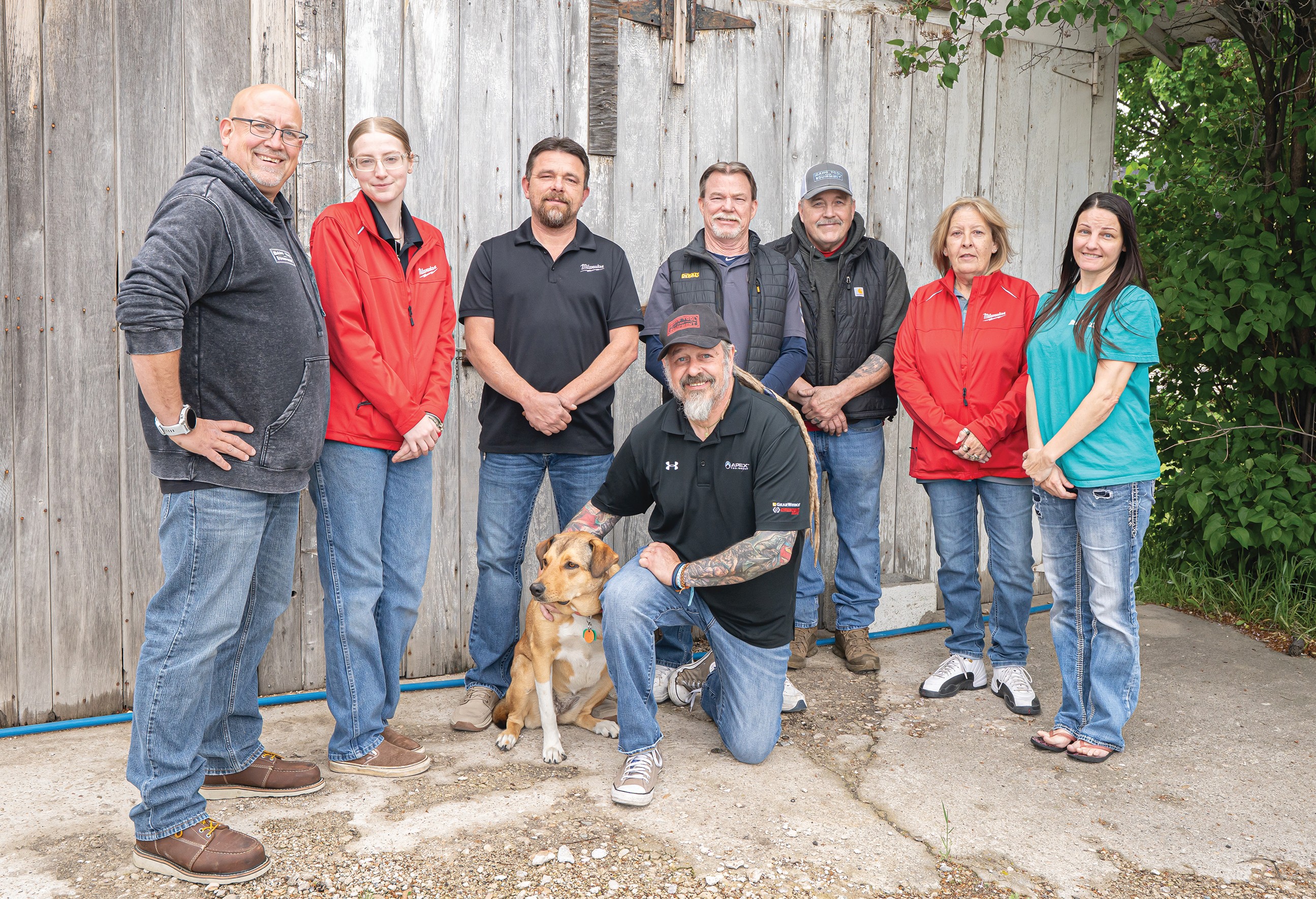
Idaho Tool’s staff consists of only 10 people, including from left to right: Brandon Guthrie, Cecilia Crofutt, Rick Aldrich, Rayne (shop dog), Bradley Kuskey, Scott Chadwick, Ric Whisenant, Laura Martin, and Magen Nielsen. |
POWER OF RELATIONSHIPS
Central to Idaho Tool’s success is the expertise of its long-tenured staff. A group of ten people, ranging in age from 21 to 63, keeps the store operating.
The staff fills a variety of roles, from salespeople, service technicians, administrative roles, and logistics support, since responsibilities are fluid.
“Everybody here wears more than one hat,” Brandon says. “We just do it all, and everybody pulls their weight, and nobody complains. We’re a big family.”
He was fortunate to inherit a long-tenured staff. While he brought strengths in systems and process optimization, he readily acknowledges that the existing team provided the operational insight necessary to avoid early missteps.
Key among them was general manager Laura Martin, who has been with the company for over 30 years, and plays a pivotal role in purchasing and customer relationships.
“She knows just about everybody,” Brandon says, noting that her relationships with customers, suppliers, and more run very deep.
Laura’s history with the company and industry knowledge proved especially critical during the ownership transition and in guiding him through his learning curve.
“Laura absolutely saved me from wrecking what was here,” Brandon says. “I can’t say how important she is to our organization.”
Her expertise in a male-dominated industry is on display via the daily customer interactions. Customers will come in, and she’ll start helping them.
“Sometimes they’ll walk away and find a male salesperson,” Brandon says. “Then we’ll say, ‘Did you ask Laura?’ And once they realize what she knows, their perspective changes completely.”
The exchange is a reminder of both the depth of knowledge within the team and the importance of earning trust.
“What I understand are systems and processes,” Brandon says. “What I didn’t have was the product knowledge and the relationships. The staff filled that gap.”
Like most businesses, most employees spend more time at work than with their families, so that culture is reinforced with that sense of cohesion. It is further enhanced through shared activities and recognition of milestones.
Celebrating birthdays, anniversaries, and achievements is a critical part of retaining staff and maintaining morale.
“We definitely earn their loyalty,” Brandon says. “We try to do all those things to recognize the people, because people are what keep us in business. We have a good time, and that’s what brings them back here every day.”
The sense of cohesion among the staff translates into friendlier customer interactions.
“We’re a friendly bunch,” Laura says. “We don’t lie to people. If we don’t know something, we’ll tell them, but we’ll also figure it out.”
The Idaho Tool reputation is based on the knowledge, experience, and trust of its staff.
“If we ruin that, it’s almost irreparable,” Brandon says.
Beyond its commercial activities, Idaho Tool is part of the Nampa community.
The company supports local initiatives such as Shop with a Cop, as well as agricultural programs like FFA and 4-H.
These efforts reflect a broader commitment to contributing to the community that has supported the business for decades.
 |
|
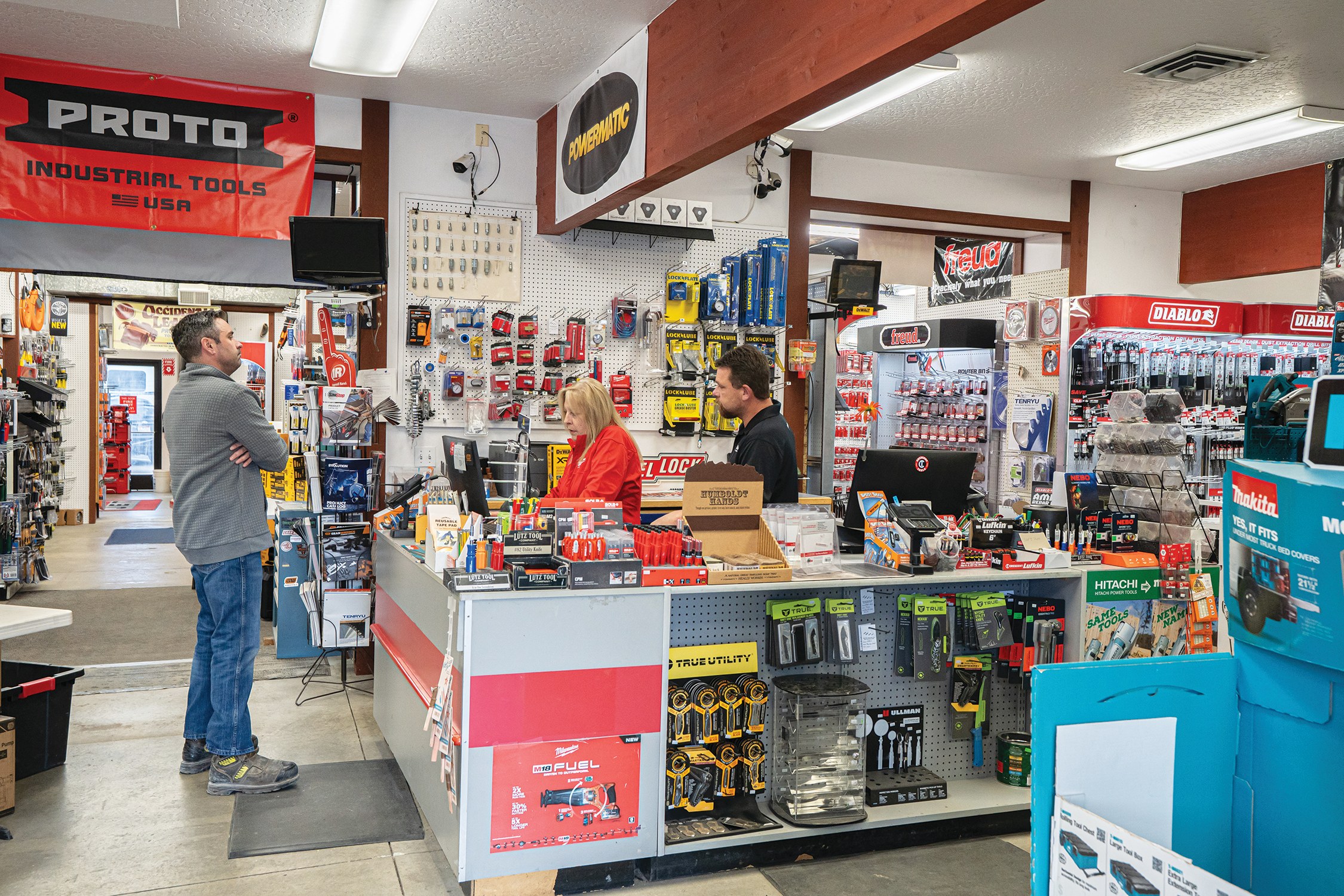
The staff at Idaho Tool provides the operational insight to ensure continued success. Key among them shown here, is general manager Laura Martin, who has been at Idaho Tool for over 30 years. |
TARGETED INVENTORY
Modernizing the business has been a priority since Brandon took ownership.
When he arrived, Idaho Tool was running a 1990s version of an Epicor program on a 25 to 30-year-old computer.
“Nobody knew how to do anything on it anymore because it was all a custom business language,” he says. “It was a linchpin.”
Replacing that system was one of his first major initiatives. The store transitioned to a new platform in 2021, improving functionality but also introducing challenges related to data migration and workflow changes.
“We like our software, but we don’t love it,” Brandon says. “There’s still room for improvement.”
The outdated computer stopped working in 2022, taking with it some of the store’s old data.
Another operational gap was inventory management. “They hadn’t done a physical inventory in decades,” he notes.
Addressing these foundational issues has positioned Idaho Tool for more data-driven decision-making, though Brandon continues to rely on his own methods for analyzing performance.
Before he acquired the business in 2020, Idaho Tool had developed a reputation as a place where customers could find anything, if they were willing to dig for it.
The original owners’ inventory philosophy was simple: if it could be sold, buy it, and eventually, it would move.
While the approach created a vast and eclectic assortment, it also introduced several inefficiencies.
Customers would come in and root through boxes of tools to find what they needed.
Neither Brandon nor Laura shares that approach to the business.
“There are still customers who come in and say they miss that, and I tell them, yeah, it’s not like that anymore,” Laura says. “I kind of like some organization to the place.”
Under Brandon’s leadership, the store has transitioned to a more structured inventory system, while still maintaining depth and breadth.
Today, Idaho Tool stocks between 18,000 and 20,000 items, with access to significantly more through co-ops, supplier networks and industry trade groups such as Sphere 1 and STAFDA.
“As an owner-member of Sphere 1, we’ve really been able to open doors we didn’t have before,” Brandon says. “We’ve met reps from some companies we’ve always wanted to do business with, but we just couldn’t get a foot in the door because we just weren’t in their vision.”
He says having an advocate with stronger contacts is helpful for solving problems and achieving results that improve customer satisfaction.
Connections made through STAFDA membership have also provided insights into operational and new-product options.
“We’re always looking for something new and different, and it’s hard to find those new things that are really kind of eye-opening without these relationships,” Brandon says.
A B2B BACKBONE
Idaho Tool caters to all trade professionals looking for tools and accessories. Just don’t come in looking for fasteners, hardware, or lumber.
“We are that traditional tool store,” Brandon says. “You walk in here, and we have a little bit of everything.”
Approximately 80% to 85% of Idaho Tool’s sales are in a businessto- business model, serving professionals whose livelihoods depend on the performance and reliability of their tools.
General consumers and DIYers make up the rest of the business, but the core is rooted solidly in the trades.
One of the largest trade segments Idaho Tool works with is mechanical repair, whether it’s heavy equipment, automotive, or other areas.
Manufacturing is also a substantial focus.
“There are so many different markets here that we can service,” Brandon says.
Seasonality plays a role in what sells.
“At different times of the year, we’re busy with woodworking machines, and other times it’s metalworking,” Brandon says.
Even after six years of owning the business, one thing that continues to surprise him is how many 60 gallon and larger air compressor units are sold throughout the year.
Another challenge he faces relates to how customers shop for their tools.
As construction firms and other customers’ procurement personnel get younger, they are more inclined to shop online for their tool needs, opening themselves to the risk of improper tool selection and overall lack of support.
In many cases, those purchasing decisions lead to problems in the field.
“The guys using the tools will say, ‘Why did you get this? Did you talk to Idaho Tool?’” Brandon says. “It might save some money, but it works for one day, and then they’re down again.”
Fortunately, such mistakes typically bring customers back to Idaho Tool.
“The seasoned crew members doing the work tend to drive business back to us,” he says.
The expertise of Idaho Tool’s staff, combined with its ability to provide immediate solutions, reinforces the value of the store’s relationship-based approach and has to date prevented Brandon from pursuing much of an e-commerce presence.
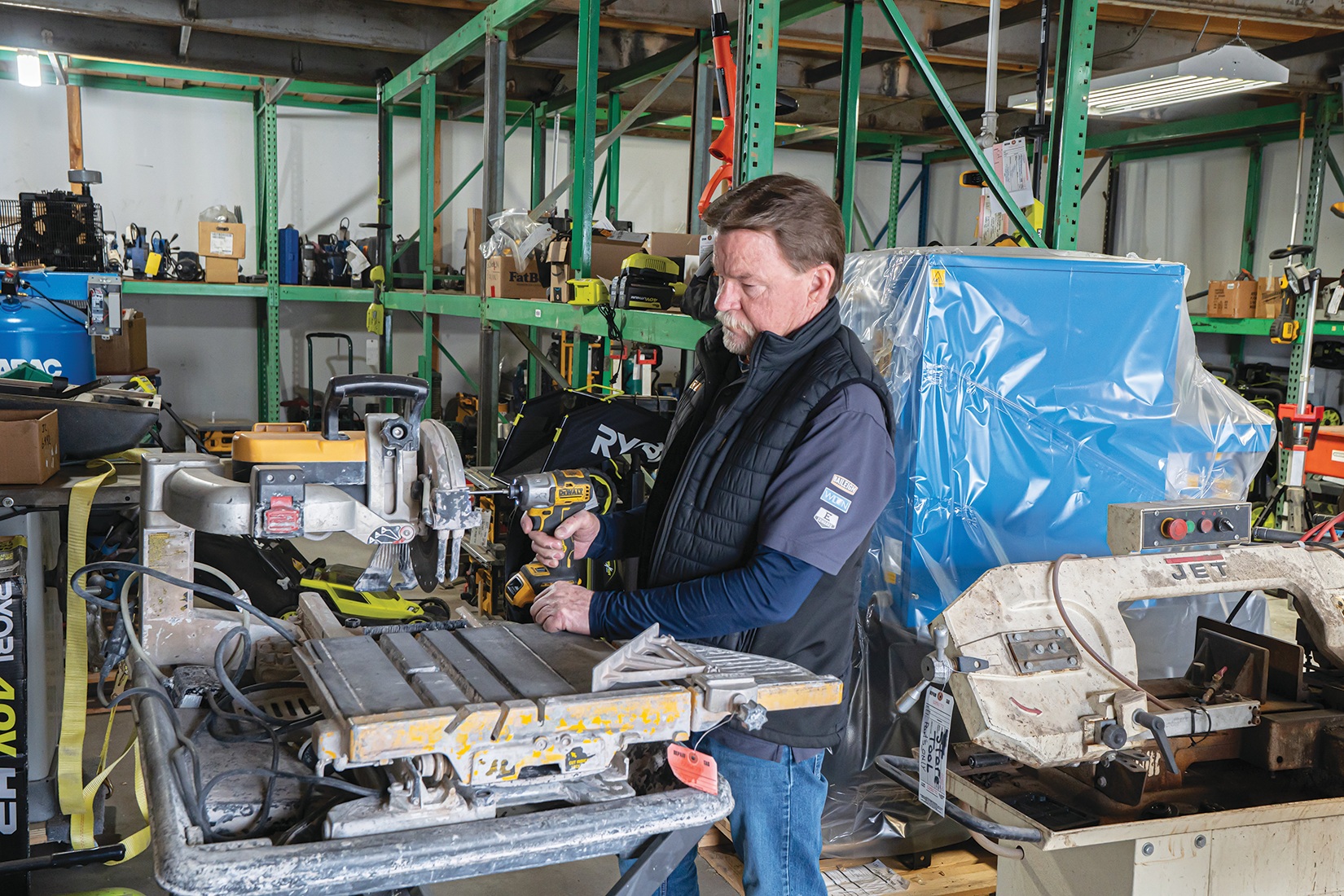 |
| Idaho Tool maintains a full-service repair department, handling everything from warranty claims to routine maintenance. Above, service tech Scott Chadwick is trained on a number of brands. |
SERVICE DIFFERENTIATOR
If there is one area where Idaho Tool sets itself apart, it’s service.
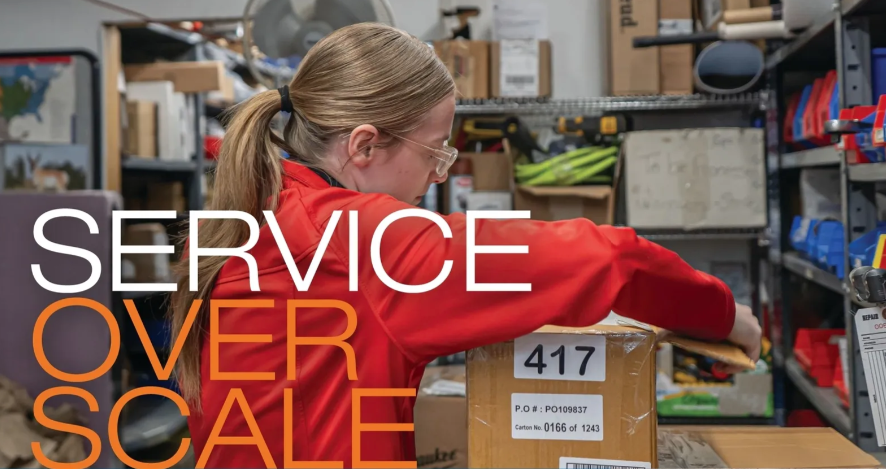
The store operates a full-service repair department, handling everything from warranty claims to routine maintenance.
“We offer full service for anything we sell,” Laura says. “And even things we don’t sell.”
Big-box retailers that might be seen as direct competition in other markets are viewed differently by Idaho Tool.
“They’re not competition to us, they help us, because they just don’t do the type of service work we do,” Laura says.
While big box or larger retailers excel at volume and pricing, they typically lack the depth of service and expertise that Idaho Tool provides.
For example, Home Depot shuttered its service centers about four years ago.
When customers buy a tool at a Home Depot, Lowe’s, or other competitor, if the tool breaks down or needs repair, they are often directed to Idaho Tool.
“Nobody does the product depth that we do for repair,” Brandon says. “Some stores will do the type of products they sell, but don’t service an entire product line. Manufacturers like us because we don’t make that distinction.”
Many consumers, even professionals, don’t consider quality or brand and tend to be more price sensitive.
“We don’t tend to win on the price side because we don’t carry the Harbor Freight type products and price model,” Brandon says.
Importantly, the focus at Idaho Tool is not on being the cheapest option, but rather on a reputation for quality products, knowledge, responsiveness, and advocacy.
“The tools we carry, the products we carry, we have a strong philosophy that we need manufacturers that support us so we can support our customers,” he says. “If we can’t have somebody stand behind their product, so we can stand behind it, it really isn’t something that fits with us.”
In addition, on the power tool side, the manufacturer reps are loyal.
Although they can’t actively advertise the business since that would be considered favoritism, when it comes to getting tools fixed, reps will drop Idaho Tool’s name as the place to go, which certainly helps get more people through the door.
“They’ve been fantastic driving business our way with all the growth out here,” Brandon says, noting that overall, they have excellent working relationships with the sales reps with the different manufacturers.
Beyond repair, Idaho Tool positions itself as an advocate, something that is simply not seen outside of independent retailers.
“We’re not afraid,” he says. “We’ll go after anything anybody wants, and we’ll figure it out. When you have a problem, you come see us, and we’ll fight for you; we’re your advocate.”
Employees at Home Depot, Menards, or Lowe’s would go with whatever the corporate policy is.
“There is a value to the knowledge about the products we carry, and there’s intent behind it, to support it as much as we can,” Brandon says.
ADAPTATION
Like many in the contractor supply channel, Idaho Tool has faced significant external pressures in recent years.
“COVID was difficult,” Brandon says. “But 2025 was worse.” Tariffs, pricing volatility, and supply chain uncertainty created a challenging environment.
“It really put the screws to a lot of the smaller businesses because it was difficult to keep up with the pace of change,” he says.
Price files with changes were coming in every two weeks from some companies, with the fluctuations being up one week and down another.
“I don’t think there’s any software out there that would manage that,” Brandon says. “It really was a difficult thing for us to navigate. We made it through, but I didn’t like it.”
Subsequently, the Middle East conflict has added further complexity due to the impact on fuel costs.
“Petroleum products go into everything we do, whether it’s transportation, packaging, manufacturing, plastics, whatever it is, it goes in everything,” he says.
The longer the conflict continues, the more price fluctuations will be felt by small businesses.
“There’s a point where the larger corporations will absorb some of it, but once they exceed their expectations, they’ll start passing it along to us, which we will have to pass on to the consumer,” Brandon notes. “They’re going to look more profitable, while the consumer and the distributors and retailers are all going to be the ones who pay the price for it.”
Despite these challenges, Idaho Tool has remained resilient by focusing on its strengths in service, expertise, and industry relationships.
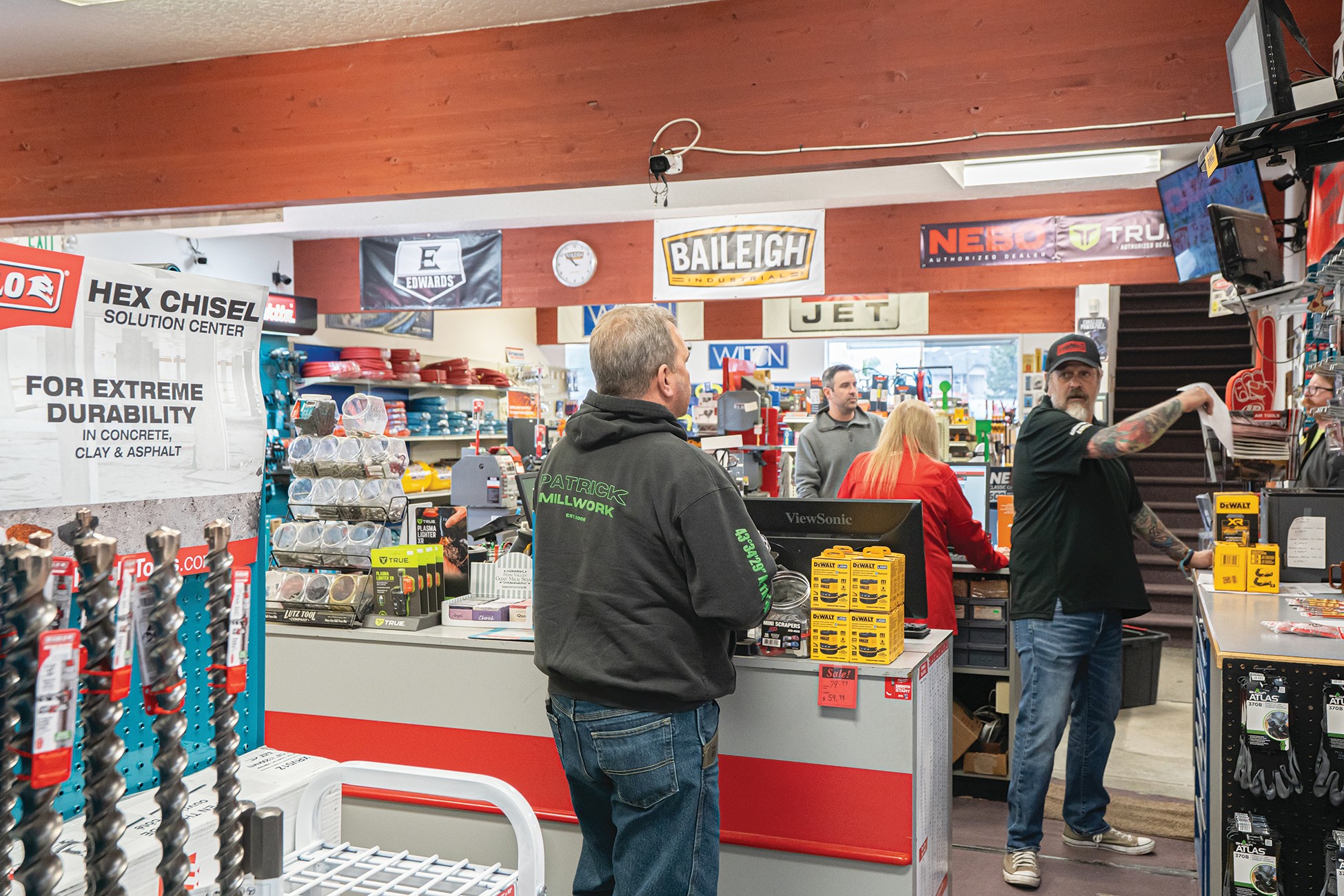 |
| The close-knit nature between employees and customers is a significant part of Idaho Tool’s success. |
STAYING TRUE
 |
As Idaho Tool looks to the future, its strategy is defined as much by what it will not do as by what it will.
Over his six years of ownership, he has been approached several times about selling.
“The damage it would cause to what I perceive as our value proposition did not outweigh any financial gain,” Brandon says. “These are good companies, but their models don’t overlap enough, and because of that, I just wouldn’t feel comfortable doing that.”
The close-knit nature of the employees and customers is key to Idaho Tool’s success.
“I would hate to see that get destroyed because I fear we would just have cashiers and they don’t know anything other than scanning a barcode, collecting a payment and getting people out the door,” he says. “We want our staff to be able to answer questions, to have knowledge, and that experience where they can really provide that differentiated service.”
As the industry evolves with the times, so will Idaho Tool.
“I think it’s part of the draw we have,” Brandon says. “We don’t do everything, but we’re really good at what we do, and that’s what keeps people coming back.”
From an attrition perspective and just a general business plan perspective, it is always at the front of his mind that a third of his staff is nearing retirement.
For example, one of his primary technicians is nearing retirement age, and finding technicians has been difficult.
“We can’t find people who really want to fix things anymore, so it’s going to become a problem,” Brandon says, noting that they are always keeping their eye out for people who might be interested in that aspect of the job.
Meanwhile, Laura is also on the shortlist of those nearing retirement. She currently manages about 75% of the buying, and he picks up the remainder.
This issue is particularly significant given the emphasis on expertise and customer service.
“When she’s ready to leave, I’ll have to hire two people to fill that role,” Brandon said. “It is one of those things that is absolutely a concern, and where, if we had a bigger base with more stores, we could balance it out a little better.”
Looking ahead, Brandon does have ambitions to grow Idaho Tool’s business model.
His goal is to add two or three more locations.
“We sit about 15 miles west of Boise, and for a lot of people, they just don’t want to commute that far to come see us,” Brandon says. “Having something in Boise would be great.”
In addition, about two hours south of Idaho Tool is Twin Falls, Idaho, an area he says has a lot of industrial growth, and in which a store like Idaho Tool closed about two years ago.
Ideally, Brandon says any additional locations would fall within a 300-mile radius to keep inventory and staff management more direct.
However, any expansion is constrained by capital requirements, particularly inventory.
“The inventory capital really is what’s slowing me down, because it wouldn’t triple my inventory, but it would easily double it,” he says. “To make that work requires capital we just don’t have.”
Conversely, Brandon says organic growth without geographic expansion, through an outside sales team, could provide sufficient revenue for future locations.
Currently, Idaho Tool’s efforts are based on inside sales, with Brandon having a few outside sales touchpoints during deliveries.
With the growth in southwest Idaho, he believes having an outside sales force that touches customers and lets them know about Idaho Tool would be a huge benefit.
For example, Brandon says the store has gained a lot of new business from the construction of the new Micron Technology facility.
While he would love to move toward having an outside sales team, finding people with even a baseline of tool knowledge to fit such roles has been challenging.
“I know enough to be dangerous, because we pride ourselves on our knowledge and being able to help a customer get the right product, and if you don’t have that knowledge or take that time to ask questions, you really can do more damage to your business than help,” Brandon says. “I lean heavily on my veteran staff to ensure I am not giving bad product information as I continue to learn.”
At its core, the company remains committed to its foundational principles. It does not seek to be everything to everyone, but rather to excel within its chosen niche.
By maintaining a focus on quality, service, and trust, Idaho Tool aims to continue building long-term value for its customers and employees.
Coming into retail is a different game for Brandon, and that has required him to shift his expectations and overall view of the world.
“We just keep doing what we do, and in the end, we do have growth aspirations, because that’s my retirement,” he says. “It’s about getting Idaho Tool to a point to where I can retire and know that I’ve set something up to succeed and continue on without me.”
The hope is to accomplish that goal over the next 10 to 15 years.
“If we can get to that three to four store operation, I’ll call that a win, and we have kind of a rough plan to get there,” Brandon says.
While it is not as financially lucrative as where he came from, he loves what he does.
“I don’t dread coming to work every day, I truly love what I do now,” Brandon says. “We’re going to have our battles, and we’re going to have our wins, but ultimately, we’ll figure it out.”
Photos by AI Photography, https://www.airealtyphoto.com/
This article originally appeared in the June/July 2026 issue of Contractor Supply magazine. Copyright, 2026 Direct Business Media.

CONTRACTOR SUPPLY MAGAZINE
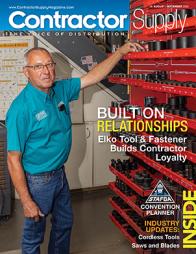
The August/September 2026 issue of Contractor Supply magazine is here!
In our cover story, Built on Relationships, Elko Tool & Fastener of Elko, Nevada has found success in the mining market by offering good customer service.
Also in this issue are Industry Updates.
This digital edition, sponsored by BECK AMERICA Inc., is fully searchable and contains live links to every advertiser and new product listing. Click away!
| Read the Articles Read the Digital Edition |